Showing posts with label Marvel. Show all posts

Tuesday, December 25, 2018

🎄Comic Review: Ms. Marvel #31, "One Night Only"🎄

Writers: G. Willow Wilson, Saladin Ahmed, Rainbow Rowell & Hasan Minhaj

Artists: Nico Leon, Gustavo Duarte, Bob Quinn & Elmo Bondoc

A remarkable milestone issue that celebrates the best aspects of Kamala Khan’s character while progressing towards an even greater future!

Ranking: ⭐⭐⭐⭐⭐

Happy Holidays everyone! You know, with all the negativity currently going on in the world at large, I feel that it’s important for us to be reminded every so often that positivity still exists out there. And seeing as how today is Christmas, a milestone holiday that occurs only once every year, what better way to celebrate it than with review of a milestone comic issue. As such, my holiday present to you all is a review of MS. MARVEL’s 50th issue “One Night Only!”

For those who are unaware, milestone (or anniversary) comics are issues of a long-running comic series that celebrate the anniversary of said-series and its respective characters. These issues are meant to be special events, as they primarily occur when a series reaches its fiftieth or hundredth issue (or in the recent case of ACTION COMICS, its one thousandth issue…) and are often extra long or double-sized in length. To put it into a mathematical perspective, the average length of a standard single issue comic ranges from 21 to 25 pages, whereas the length of a milestone issue can range from 34 to 45 pages. Because of their additional length, the creative teams of these particular issues are under increased pressure to produce a story that’s not only high in quality but also succeeds as a celebration of the series' anniversary and characters. When these efforts are successful, you end up with truly fantastic stories like AMAZING SPIDER-MAN #400, “The Gift,” which not only told the story of Aunt May’s death during THE CLONE SAGA but also dedicated its entirety to honoring the character's legacy and the importance of her relationship with Peter Parker. On the opposite end of the spectrum, however, you have AVENGERS #200, “The Child is Father To…?,” which not only had Carol Danvers being raped by a super villain but also portrayed the rest of the Avengers as complete idiots who made no attempt to comfort Carol or to stop her from falling in love with her rapist and leaving to live in limbo with him.

Good Milestone Issues vs. Bad Milestone Issues. (Left) From Amazing Spider-Man #400 (Apr 1995). Art by Mark Bagley and Larry Mahlstedt.
(Right) From Avengers #200 (Oct 1980). Art by George Pérez and Terry Austin. Copyright © Marvel Entertainment. 
Something that I’ve come to notice regarding the milestone issues published by Marvel is that they tend to follow a structure similar to that of Charles Dicken’s novel A CHRISTMAS CAROL in that they tend to be celebrations of a series or characters’ past, present, or future. For anniversary stories that focus on the past, Marvel will often simply pay homage to or feature the return of classic elements from the series such as the case with X-MEN #100 having the all-new X-Men fighting sentinels disguised as the original five X-Men. Milestone issues that focus on the present tend to be more varied, ranging from being the concluding chapters for ongoing storylines, such as with IRON MAN #200 being the finale to “The Iron Monger Saga,” to standalone issues with an emphasis on character development over action like with “The Trial Of Magneto” from UNCANNY X-MEN #200. And milestones that focus on the future are usually celebratory in the manner that they set the stage for future stories, either by introducing a new characters or villains like Venom in AMAZING SPIDER-MAN #300, or plot twists like the reveal of Magneto’s tragic origins as a Holocaust survivor in UNCANNY X-MEN #150. In my personal opinion, however, the best type of milestone issues are the ones that incorporate elements from not just one but all three areas of time. Stories that have the characters either reflecting or encountering elements from their past, demonstrating how they have changed and developed since their initial beginnings, as well as contemplating and looking towards their futures. These elements are all presented in the subject of today’s review, MS. MARVEL #31, “One Night Only,” which serves as the fiftieth issue of the series overall!

Now immediately you’re probably confused as to how MS. MARVEL #31 could possibly be the fiftieth issue of the series. Well the thing is, is that Kamala Khan’s series actually runs across two separate volumes. The first volume of MS. MARVEL ran for a total of nineteen issues but following the crossover event SECRET WARS in 2015, all of Marvel’s books were canceled and then relaunched with new number ones. While this strategy has made keeping track of a series’ continuity an incredibly daunting task for even long-time readers, it has proven to be a financially successful strategy since number one issues tend to sell more than their contemporaries and has thus been an ongoing practice throughout comics’ history. Following the relaunch the series ran for another thirty one issues and when you add in the previous nineteen issues from the first volume, that would make MS. MARVEL #31 the fiftieth issue of the series to be published.

The Magnificent Ms. Marvel. From Ms. Marvel Vol. 3 #19 (Oct 2015). Art by Kris Anka. Copyright © Marvel Entertainment. 
Nevertheless, as I mentioned back in my review of MS. MARVEL (VOL. 8): MECCA, Kamala Khan has easily become my second favorite comic book hero of all-time, surpassing even Batman and the X-Men. Kamala is immensely relatable due to her adolescent struggles, nerdy personality, and strong desire to do good for her community and help those in need. While it is certainly important that she provides greater diversity and representation to the Marvel Universe because she is Muslim, her creators G. Willow Wilson and Sana Amanat perfectly understood that the character would not last if her Islamic faith was the only aspect of her personality and thus set out to make her a character as genuinely authentic and realistic as possible. Although Wilson was still initially skeptical about the character’s chances of success, she later stated in a 2016 TEDx Talks appearance that “within a few months no one was calling [Kamala Marvel’s first Muslim leading lady anymore, but] were calling her this generation’s Spider-Man.” In essence, MS. MARVEL proved to be a critical and financial sensation that defied everyone’s expectations due to her being a character that not just Muslims but all audiences could connect with and relate to. Because of the character’s unprecedented success, Wilson and Amanat knew that MS. MARVEL’s fiftieth issue (a milestone which neither them believed that they would ever reach) needed to be a special event that demonstrated how the character has enriched various peoples’ lives. To achieve this, it was decided to bring on three additional writers who would tell their own individual MS. MARVEL stories. These guest-writers include science-fiction author and poet Saladin Ahmed, the current writer of the comics EXILES and MILES MORALES: SPIDER-MAN; Young Adult novelist Rainbow Rowell, the author of novels like ELEANOR & PARK and Marvel’s revived RUNAWAYS series; and professional comedian Hasan Minhaj, DAILY SHOW host and the writer/star of the film HOMECOMING KING. Furthermore, each of the three stories are illustrated by different artists, Gustavo Duarte, Bob Quinn, and Elmo Bondoc, and are all separated an overarching main plot by Wilson and artist Nico Leon that focuses on Kamala struggling to have a slumber party with her friends. The final product of this creative gathering, MS. MARVEL #31, “One Night Only,” is a milestone issue that celebrates the lighthearted and somewhat goofy spiritedness of Kamala Khan’s past stories, honors the down-to-Earth traits that make her the hero she presently is today, and serves to progress and introduce plot elements and character development for future stories.

(As a brief aside, there will be spoilers for this issue throughout this review, including the ending. If you’re legitimately curious, I highly suggest stop reading this review and go out and buy MS. MARVEL #31 right now, as well as the entirety of G. Willow Wilson’s run on the series! Trust me, you won’t regret it!)

The fiftieth issue of MS. MARVEL opens on a Saturday night at the Khan residence where Kamala is preparing to host a slumber party for her best friends Nakia Bahadir, Zoe Zimmer, and Michaela “Mike" Miller. While Kamala’s mother fails to grasp the logic behind having a sleepover, Kamala stresses that it’s meant to be a special bonding experience. Their humorous spat is interrupted by her friends arrival, thus marking the beginning of what Kamala hopes to be one night free of crime fighting. A night where she can just be a normal teenage girl engaging in normal teenage girl activities. But as Kamala has been forced to learn throughout her superhero career, being “normal” is a concept that has never really applied to her life. The slumber party initially starts off strong with the girls discussing Kamala’s first kiss from the SOMETHING NEW arc as well as providing their own respective views on boys and dating.
 
The girl's views on boys and dating. From Ms. Marvel Vol. 4 #31 (Jun 2018). Art by Nico Leon. Copyright © Marvel Entertainment.
However, it is quickly interrupted by a series of unwelcome intrusions that force Kamala to repeatedly abandon her own party and go into action as Ms. Marvel. Over the course of the night, Ms. Marvel is forced play an intergalactic game of chase with Lockjaw and a teleporting cat, deal with an angry pizza woman possessing skunk powers, and team up with Miles Morales to prevent New York’s water supply form being poisoned. Finally, tired of it all, Kamala makes a shocking decision that will forever alter the course of her career as Ms. Marvel as well as her friendships with Nakia, Zoe, and Mike!

MS. MARVEL #31, “One Night Only,” is undoubtably one of the best stories to come out of G. Willow Wilson’s MS. MARVEL series, second only to the MECCA arc in terms of being my personal favorite! The issue manages to celebrate the best aspects of Kamala’s character from a past, present, and future perspective whilst doing so through the voices eight distinctive creators. At its core, the issue is composed of three separate mini-stories within a larger overarching plot, each of them having their own individual writer and artist. Although this could have easily served to the book’s detriment, the creative team effectively manages to weave all four narratives into a single cohesive whole, which is a feat especially deserving of praise. The problem with having multiple creators collaborate on a single book is that their respective styles will usually clash with one another, thus resulting in conflicting tones that can easily distract the reader. Thus, collaborative books are incredibly difficult produc even for writers who share similar styles and characteristics. For instance, although C.S. Lewis and J.R.R. Tolkien were both Christian authors who wrote high-fantasy novels, as well as good friends with each other, the two were unable to finish a collaborative book entitled LANGUAGE AND HUMAN NATURE since they were vastly different in how they incorporated themes of faith into their works. Despite this, I feel that collaborative efforts can still succeed if the creators are able to adjust and balance their individual characteristics to match those of their partners, thereby reducing the risk of tonal shifts. One of the methods in which MS. MARVEL #31 accomplishes this is by utilizing Kamala’s slumber party as a framing device in which the other mini-stories are juxtaposed. While the main sleepover plot is written by G. Willow Wilson, the side plots feature Kamala as Ms. Marvel are all written by Saladin Ahmed, Rainbow Rowell, and Hasan Minhaj respectively. The comic makes effective use of transitions between writers by having each mini-story beginning with Kamala’s party being interrupted by some random outside force, and ending with Ms. Marvel returning home to pick up where she previously left off. Another clever touch that I noticed is that Wilson’s sleepover plot always takes place inside Kamala’s house whereas each of the min-stories take place outside, thereby making the transitions feel more natural and consistent. This is made clearer in the artistic department, with the exception of two occasions; all the bits taking place inside the Khan’s residence are illustrated by Nico Leon, but it always switches over to a different artist whenever Kamala exits the house.

Transitions between different artists. From Ms. Marvel Vol. 4 #31 (Jun 2018).
Art by Nico Leon and Gustavo Duarte. 
Copyright © Marvel Entertainment. 
But most impressively, each of the guest authors manage to have their writing styles reflect Wilson’s usual dialogue, characterization, and tone so well that I could’ve sworn that the entire issue was by Wilson herself if not for the fact that there are multiple artists onboard to indicate the transitions between writers. Furthermore, all of the stories share a purpose by focusing and building up towards Kamala’s growing stress of living a double life. So, while each of them possess their own individual plots and messages, they all share a single thematic focus that helps connect them all together. In large measure, ONE NIGHT ONLY greatly succeeds as a collaborative work between four writers and four artists through its effective use of transitions and the maintenance of a consistent tone and thematic focus.

While it’s certainly impressive that the creative team manages to connect all of their stories together into a larger single work, the individual plots themselves are all great and are each reflective of the fundamental elements that make up Ms. Marvel’s mythos. And while it was probably unintentional, I personally feel that the three mini-stories individually highlight elements that are symbolically reflective of Ms. Marvel’s past, present, and future. The first by Saladin Ahmed and Gustavo Duarte focuses on Ms. Marvel helping the Inhuman’s teleporting dog Lockjaw chase a cat that transports them distant planets with warring alien factions.

Ms. Marvel plays intergalactic chase with Lockjaw. From Ms. Marvel Vol. 4 #31 (Jun 2018).
Art by Gustavo Duarte. 
Copyright © Marvel Entertainment. 
While in my opinion this is easily the weakest of the three mini-stories, it does effectively represent the lavishly ludicrous elements that predominated Ms. Marvel’s early adventures. Despite her stories always being centered around adolescent struggles, when Ms. Marvel first debuted, she was regularly teaming up with heroes like Wolverine and Lockjaw to fight giant mutant sewer alligators, and her first arch nemesis, the Inventor, was a mutated clone of Thomas Edison with the head of a cockatiel. Plus, when Kamala was temporarily a member of the Avengers, she helped combat time-traveling dictators and interdimensional alien warlords. In that sense, Ahmed’s story accurately reflects the lighthearted goofiness that was more heavily present in Ms. Marvel’s past stories. The second story by Rainbow Rowell and Bob Quinn focuses on Ms. Marvel dealing with an enraged pizza woman stricken with the Inhuman power to smell like a skunk from vandalizing the Khan’s house. Rather than having an all-out fight with “Skunk Girl,” who’s depressed about her powers making her an outcast and is envious of Kamala’s happiness, Ms. Marvel instead tries to appeal to her. She gives a heartfelt speech about how she too is an Inhuman, and how although neither of them can reclaim their former lives they can still adjust accordingly and find happiness.

Ms. Marvel comforts "Skunk Girl." From Ms. Marvel Vol. 4 #31 (Jun 2018). Art by Bob Quinn. Copyright © Marvel Entertainment. 
This is highly reminiscent of the series’ recent stories being more grounded in reality and tackling serious issues like gentrification, profiling, cyberbullying, teenage depression and romance as well as a stand-in for the Trump administration. It’s also reflective of MS. MARVEL’s central themes about the adolescent struggles of learning to accept oneself and turning what others might perceive as weird or different into one’s greatest strengths. In this regard, Rowell’s mini-story is easily the my personal favorite of the bunch! The final story by Hasan Minhaj and Elmo Bondoc focuses on Ms. Marvel teaming up with Miles Morales, the Ultimate Spider-Man, to stop Nazi super villain Arnim Zola from contaminating New York’s water supply with deadly chemicals, but the two have to break into a government facility in order gain access to reservoir’s computer system. This results in comedic banter and antics between the two as they infiltrate the building, along with a scene where Miles accidentally drops a magic mood stone that inadvertently forces him to confess harboring semi-romantic feelings towards Ms. Marvel. While the mood stone itself is incredibly silly (unsurprising coming from a professional comedian like Minhaj), it serves an very important purpose in establishing future developments for Ms. Marvel. When Miles confesses his feelings and states that “having one less [secret] lightens the load,” Ms. Marvel comes to the realization that she needs to be honest with herself, too, and that “maybe it’s time for [her] to lighten the load” as well.

Ms. Marvel decides to lighten the load. From Ms. Marvel Vol. 4 #31 (Jun 2018). Art by Elmo Bondoc. Copyright © Marvel Entertainment. 
In large measure, Minhaj’s story lays out potential directions for future Ms. Marvel stories to branch out towards while also foreshadowing a crucial moment that occurs within the fiftieth issue itself. Overall, the guest-writers’ mini-stories are individually reflective of the best elements that compose Ms. Marvel’s past, present, and future.

While each of the guest-writers' plots are great in their own right, it is the main overarching plot by G. Willow Wilson and Nico Leon involving Kamala’s sleepover that is the most important since it encapsulates what is essentially the overall heart of the series: Kamala Khan herself and the relationships she shares with her supporting cast. Since the start of her series, the character has always been centered around the adolescent struggles of wanting to fit in according to society’s standards whilst overcoming this mindset by learning how to accept and embrace themselves and others for who they truly are. While Kamala has always felt different due to her Islamic faith, geeky personality, and acquisition of Inhuman powers, she’s always relied upon two sources of strength that have contributed to her evolution as a hero: her family and her friends. While Kamala’s parents endowed upon her the desire and moral obligation to do good for her community, Kamala’s friends have served as beacons of guidance and encouragement, especially whenever the stress of her mission becomes too much to bear. The latter idea is the central focus of ONE NIGHT ONLY, as Kamala’s primary purpose for hosting a slumber party is for her to become more open and intimate with her friends. This is effectively demonstrated at the start of the sleepover when Kamala confesses to her friends about having shared her first kiss with the Pakistani vigilante Red Dagger two issues prior, and how it caused her to undergo spiritual crisis since she still harbors feelings for her childhood best friend Bruno. But while Nakia, Zoe, and Mike are all too eager to try and help Kamala sort out her feelings, she is unable to listen to them as she’s repeatedly forced to awkwardly push them aside whenever an interruption involving Ms. Marvel occurs. This repetitious cycle ultimately leads to the issue’s stand-out moment where, after dealing with interruption after interruption, Kamala returns upstairs to her friends while holding her costume in her hands, stating to them that she is in fact Ms. Marvel.

Kamala reveals her secret identity. From Ms. Marvel Vol. 4 #31 (Jun 2018). Art by Nico Leon. Copyright © Marvel Entertainment. 
To which her friends reveal that have known Kamala’s secret for a long time and have been waiting to provide her their support, and then the issue ends with their embracing Kamala in a group hug.

This scene is easily my favorite moment of the entire issue! It further underscores the importance of Kamala’s relationships with her friends while simultaneously shattering an age-old superhero cliché. One thing that I’ve always admired about MS. MARVEL has been the series’ ability to challenge outdated stereotypes. This has been apparent since the series’ first issue which featured a scene of Zoe questioning whether or not Nakia would be honor killed if she removed her hijab to which Nakia replied that her father actually wanted her to take it off.

Nakia challenges Zoe's bigotry. From Ms. Marvel Vol. 3 #1 (Feb 2014). Art by Adrian Alphona. Copyright © Marvel Entertainment. 
But while most of the stereotypes MS. MARVEL has targeted are those centered around Islam and Muslim Americans, ONE NIGHT ONLY instead decides to focus on a stereotype that predominates the superhero genre itself: the possession of a secret identity. Since the inception of Superman in ACTION COMICS #1 from 1938, superheroes have routinely lead double lives in which they keep the activities of the mask and the man separate from one another, not only because it helps prevent the hero’s enemies from exploiting their loved ones but also because it allows writers to produce greater drama between the protagonist and their supporting cast. For instance, in the Stan Lee/Steve Ditko Spider-Man stories Peter Parker was regularly forced to lie and make up excuses to Aunt May and his classmates whenever he was forced into action as Spider-Man, which added additional stakes to Peter’s dilemmas and interpersonal relationships. But as is the case with all tropes, when a storytelling device is overused, it ends up becoming a tiresome cliché. There's only so many times Peter making excuses to maintain his secret identity can hold the readers’ interest. This is actually one the reasons why I'm a huge fan of Mary Jane revealing that she knew Peter's secret and the two getting married, since it allowed the character to evolve beyond his high school years and develop more interpersonal relationships. Essentially, removing the secret identity factor allowed Spider-Man to become more fleshed out and mature, which is another reason as to why I hate ONE MORE DAY so much since it backpedals on this character development by erasing other character's knowledge of his identity.

In regards to Ms. Marvel, I'll admit that I was a little disappointed when Wilson made the decision to keep Kamala's identity secret from her friends and family (with the exception of Bruno) at the start of the series. I was hoping for the book to follow the route of the Jaime Reyes' BLUE BEETLE series by revealing her identity to her loved ones right off the bat. But while Wilson too initially fell prey to the secret identity trope, the entirety of ONE NIGHT ONLY is dedicated to portraying how having a secret identity has been proven to be more burdensome than beneficial to Kamala and her relationships. While Kamala originally decided to keep her superhero life secret out of fear for her loved ones would react, the costs of living a double life became increasingly apparent to her as the series progressed. This was especially evident in the CIVIL WAR II tie-in arc when Kamala put Ms. Marvel’s needs above those of her friends, which resulted in Bruno ending their lifelong friendship and the two not reconciling until the issue directly preceding MS. MARVEL #31. ONE NIGHT ONLY further emphasizes this, as every time Kamala’s sleepover is interrupted she gradually realizes that her secret identity has prevented her from participating in her friends and family’s lives (as well as her own) from plans going the way she had hoped and from broadening her relationships and expressing her true self to those she cares about the most.

The price of living a double life. From Ms. Marvel Vol. 4 #31 (Jun 2018). Art by Nico Leon. Copyright © Marvel Entertainment. 
So when Kamala chooses to reveal her secret identity to her friends, she is essentially welcoming them into both halves of her life. She is not only giving herself permission to become a greater part of her friends’ lives, but her friends permission to become a greater part of her life as well. Furthermore, Kamala’s decision demonstrates that she's overcoming her previous fears of being seen as weird or different. That she is now fully willing to accept her friends’ guiding support through hardship and struggle. But most importantly, that she wants her relationships to evolve and flourish rather than to stagnate or fall apart. In essence, Kamala revealing her secret identity further ties into the themes of past, present, and future, whilst reflecting the outstanding growth and development of the character and her relationships over the course of fifty issues. It's also a testament to Wilson's growth as a writer and storyteller, since ONE NIGHT ONLY takes an element that was initially a detriment to the series and instead utilizes it to serve as part of Kamala's ongoing character arc, thereby turning past weaknesses into future strengths.

Another aspect about Kamala revealing her identity that I absolutely loved is how Wilson presents Nakia, Zoe, and Mike as having already known. This revelation beautifully struck accord with me. While the comic does provide logical explanations as for how they knew, like with Kamala “not [being] very good at hiding” her secret identity or it being “extremely guessable,” it just makes sense from a purely human perspective.
 
Kamala's friends explain how they knew. From Ms. Marvel Vol. 4 #31 (Jun 2018). Art by Nico Leon. Copyright © Marvel Entertainment. 
If there’s one truth that’s almost universal it is that no matter how hard we try to hide our secrets, the people who are most likely to figure them out or already know them are the people with whom we share the closest connections. And although sometimes coming forward with these secrets can have negative consequences, more often than not the people who care about us have already accepted them and are simply waiting to provide their loving support, a point which is emphasized through Mike’s words “We just didn’t want to make you talk about it… if you weren’t ready,” and “We just want to help! We’ve been waiting to be asked!”

Nakia, Zoe & Mike want to help Kamala. From Ms. Marvel Vol. 4 #31 (Jun 2018). Art by Nico Leon. Copyright © Marvel Entertainment. 
In many ways, this scene heavily reminded me of the moment from AMAZING SPIDER-MAN #400 where Aunt May revealed that she had always known Peter was Spider-Man and gave him her approval before passing away. It 
was one of the most beautiful and powerful scenes that I’ve ever read from not just any Marvel milestone comic but from any Spider-Man comic period.

Aunt May reveals she's always known Peter is Spider-Man. From Amazing Spider-Man #400 (Apr 1995).
Art by Mark Bagley. 
Copyright © Marvel Entertainment. 
The twist of Nakia, Zoe, and Mike knowing Kamala's secret identity was not only able to emotionally resonate with me on a similar level, but the parallels between it and the Aunt May scene are indicative of Wilson taking the fans' statements of
 Ms. Marvel being "this generation's Spider-Man" to heart. And seeing as how Ms. Marvel is now second only to Spidey in terms of being my all-time favorite superhero, its a sentiment that I wholeheartedly support.

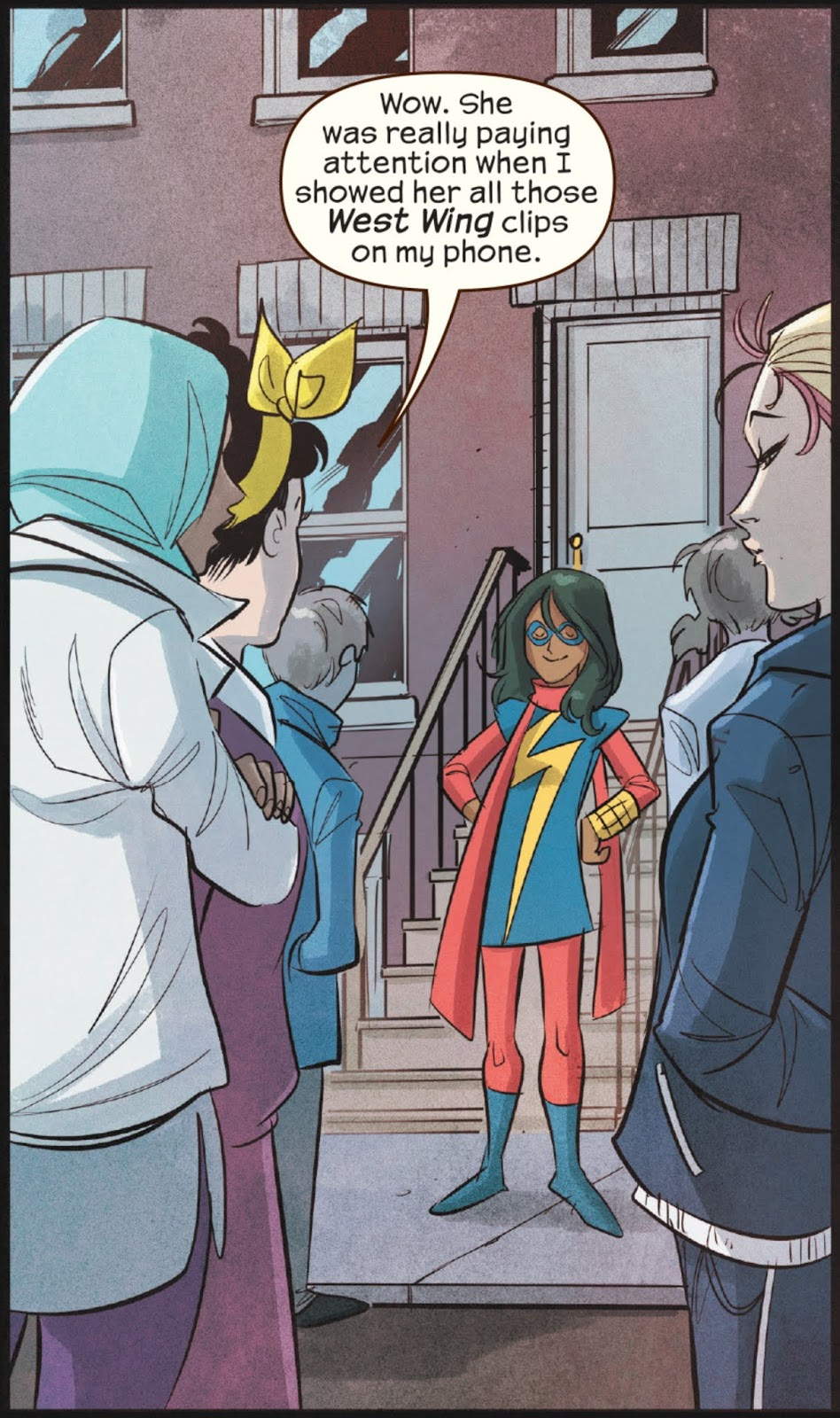
What makes this plot twist with Kamala's friends further emotionally resonate with the reader is that Wilson appears to have been building up towards this moment as early as the LAST DAYS tie-in arc when Kamala revealed her identity to her mother, to which her Ammi replied that she already knew and was proud of her daughter. In regards to Nakia, Zoe, and Mike, Wilson provided three separate scenes in which each respective character implied that they knew or discovered Ms. Marvel’s true identity. The first was with Nakia during the ELECTION DAY issue, when she helped assist Ms. Marvel in protesting against HYDRA member Chuck Worthy from running for mayor by encouraging people to vote. Initially it made little sense for Nakia to be actively helping Ms. Marvel since in previous issues she held a grudge against her. However, there is a panel in the issue where Nakia is seen in the background with her jaw dropped in awe after Ms. Marvel gives a speech about voting.
Nakia figures out Kamala's identity. From Ms. Marvel Vol. 4 #13 (Nov 2016). Art by Mirka Andolfo. Copyright © Marvel Entertainment. 
While the intention of this panel was most likely to infer that Nakia was impressed with the speech, I also interpreted it as a subtle indication of Nakia recognizing Ms. Marvel’s words as familiar, thus putting two and two together and overcoming her previous biases towards Jersey City’s resident hero. In regards to Zoe, she was more forward in implying her knowledge of Ms. Marvel’s true identity. When the evil sentient computer virus Doc.X threatened to out Zoe as a lesbian during the DAMAGE PER SECOND arc, Ms. Marvel stressed that the Doc.X virus could also potentially reveal her secret identity as well, to which Zoe replied, “If your life is anything like mine, most of the people you love already know your secrets. They’re just waiting for you to be ready to talk about it.”

Zoe alludes to knowing Ms. Marvel's identity. From Ms. Marvel Vol. 4 #16 (Mar 2017). 
Art by Takeshi Miyazawa. Copyright © Marvel Entertainment. 
This sentiment is reflected by Mike here in ONE NIGHT ONLY as I mentioned previously. Speaking of Mike, she suggests to knowing who Kamala really is during the TEENAGE WASTELAND arc when she's revealed to be in possession of Ms. Marvel’s locator pendant after witnessing the latter discard it during the CIVIL WAR II tie-in arc.

Mike hints at knowing Ms. Marvel's identity. From Ms. Marvel Vol. 4 #27 (Feb 2018). Art by Nico Leon. Copyright © Marvel Entertainment. 
The catch is that when Kamala discarded the pendant she did it in her civilian persona, meaning that Mike definitely knew that she was Ms. Marvel. Overall, the twist of Kamala’s friends knowing her true identity feels earned and doesn’t come out of left field due to solid built up from previous issues.

In large measure, MS. MARVEL #31, “One Night Only” stands tall as my second favorite MS. MARVEL story and as one of the best milestone stories to be published by Marvel. The issue wonderfully celebrates Ms. Marvel’s anniversary through the collaborative efforts of eight creators while never feeling messy or cluttered. It encapsulates all of the elements of Kamala’s past, present, and future that have made the character so appealing, but most especially it reflects the growth and development of Kamala and her relationships with her friends over the course of fifty issues. It was recently announced that following February 2019, G. Willow Wilson will be leaving MS. MARVEL after having written sixty issues and that the series will be relaunched in March as THE MAGNIFICENT MS. MARVEL with writer Saladin Ahmed (one of the guest writers featured here) at the helm. While this does sadden me, I simultaneously understand and sympathize with Wilson’s decision as she feels that she’s contributed all she has to offer to the series and that it’s time for her to move onto future projects. And just as MS. MARVEL #31 stresses the importance of progressing towards a brighter future, I wish both her and Ahmed good luck in their respective endeavors. Have a Merry Christmas and a Happy New Year!

“I will live in the past, the present, and the future. The Spirits of all Three shall strive within me. I will not shut out the lessons that they teach!”
-Charles Dickens, A Christmas Carol

Sunday, October 14, 2018

Comic Review: Iceman (Vol. 1-2)


Writer: Sina Grace

Artists: Alessandro Vitti, Edgar Salazar, Ibraim Roberson, Robert Gill & Sina Grace

Sina Grace’s Iceman series excels in its portrayal of the issues the LGBTQ community struggles with!

Ranking: ⭐⭐⭐⭐

In one of his famous soapboxes, Stan Lee wrote in the letter’s column of AVENGERS #74, “None of us lives in a vacuum — none of us is untouched by the everyday events about us — events which shape our stories just as they shape our lives. Sure, our stories can be called escapist — but just because something’s for fun, doesn’t mean we have to blanket our brains while we read it!”

Stan's Soapbox. From Avengers #74 (Mar 1970). Copyright © Marvel Entertainment.
What he meant was that although comic books are fictional fantasy at their core, they should still try to be reflective of the societal trends of the time they’re published in. The soapbox was published in response to fans who complained about the inclusion of political messages in comics.  However, Stan believed that escapist literature should serve as a vehicle for moral and philosophical discussions. This is evidenced by him alluding to the Civil Rights movement along with Cold and Vietnam Wars, which were subjects that he frequently referenced in the comics he wrote during the 1960s. I find Stan’s words to be fittingly appropriate in regards to subject of today’s review, the 11-issue ICEMAN series by Sina Grace. History seems to have repeated itself. Although ICEMAN is a well-written and brilliant series about a young man’s struggles to come to terms with being gay and further demonstrates Marvel’s efforts to become more inclusive with readers, the book has drawn significant backlash from right-leaning members of the comics' community.

But before I provide my analysis of the book itself, I need to give some lengthy background on both the character Iceman and the controversy surrounding his solo-series. For those unaware, Iceman, a.k.a. Robert “Bobby” Drake, was created by Stan Lee and Jack Kirby in 1963. As his name suggests, Bobby is a mutant with the ability to create and to manipulate constructs of ice, and he was one of the original five founding members of the X-Men. For almost fifty years the character was portrayed as a thrill-seeking jokester and ladies’ man, but, in 2015, writer Brian Michael Bendis decided to reveal that the character was secretly gay. Back in 2012, Bendis launched the series ALL-NEW X-MEN, which focused on the original five teenage X-Men being brought from the past to the present-day. In issue forty of the series, the time-displaced Jean Grey questions the younger Bobby’s flirtatious attitude after hitting on Magik, stating that she knew he was gay due to her telepathic powers, and later in UNCANNY X-MEN #600, the older Bobby reveals that he has always been gay as well when questioned by his younger self.

Jean Grey reveals that Iceman is gay. From All-New X-Men #40 (Apr 2015). Art by Mahmud Asrar. Copyright © Marvel Entertainment.
While the method in which Bobby was outed was indeed problematic in its execution (although I interpret Jean’s attitude as that of a concerned friend), I personally really loved the idea of Iceman being gay and felt it made perfect sense from a character perspective. Although Bobby has been shown to be an incessant womanizer, he was always really bad at being a womanizer, which is reflective of behavior demonstrated by some closeted gay individuals according to real-world studies. Furthermore, in stark contrast to the character’s cool and confident exterior, Bobby is shown internally to be insecure and self-doubting because he was raised by ultra-conservative parents who were unaccepting of their son’s mutant status. This, combined with the racism and bigotry the X-Men fight on a regular basis, forces Bobby to rely on humor as a shield to hide his true feelings. And seeing as how Bobby constantly tries to act hip and cool around attractive women, an individual could interpret his flirtatious behavior as the character overcompensating in order to try burying his inherent sexuality. 

Bobby expresses his true feelings. From Uncanny X-Men #600 (Nov 2015). Art by Mahmud Asrar. Copyright © Marvel Entertainment.
Additionally, the decision to have Iceman come out of the closet felt like a progressive effort by Marvel to be more reflective of our diverse and multicultural society. While Marvel has always promoted messages of tolerance and inclusion in books like X-MEN, it wasn’t until Bendis' creation of Miles Morales, an African American-Hispanic version of Spider-Man in 2011, that the company as a whole began to take shape in this direction. Marvel began creating new diverse characters like Kamala Khan (Ms. Marvel), who is a Pakistani-American Muslim teenager, and America Chavez (Miss America), America Chavez (Miss America), who is a Lesbian Latina woman from a parallel dimension, and Riri Williams (Ironheart), an African American engineering student from Chicago. Additionally, we began seeing new versions of old favorites such as a female Thor (Jane Foster) an African American Captain America (Sam Wilson; formerly the Falcon), a Hispanic Ghost Rider (Robbie Reyes), and a Korean-American Hulk (Amadeus Cho).

All-New, All-Different Marvel! From https://www.vox.com/culture/2017/4/4/15169572/marvel-diversity-outrage-gabriel.
Furthermore, Marvel also began hiring more diverse writers such Muslim-convert G. Willow Wilson for the aforementioned MS. MARVEL series, and African American journalist Ta-Nehisi Coates for the BLACK PANTHER books. Making Iceman gay felt like a natural extension of this progressive trend, so when I learned that Iceman received his own solo-series written by Middle Eastern gay author and former editor of THE WALKING DEAD comic, Sina Grace, I was naturally excited! 

Unfortunately, however, while I and several others were on board with the series, it has simultaneously been subject to massive criticisms from far-right comic book fans, in particular by Richard C. Meyer and the members of Comicsgate. I already briefly discussed the controversy surrounding Comicsgate in my review of MS. MARVEL (VOL. 8): MECCA since the movement has been centered around making racist attacks against diverse characters and creators in comics, particularly those at Marvel. In regard to Sina Grace’s ICEMAN book, this comic has been one of the most viscerally attacked books by Meyer and his followers (second only to Gabby Rivera's AMERICA, another LGBTQ-lead comic). Not only have they made videos with clickbait titles like “I rip SJW Marvel’s ICEMAN In Half Figuratively and Literally,” but Meyer has also inaccurately labeled ICEMAN as "stereotypical" and “anti-gay propaganda.” This is in spite of the fact that ICEMAN is written by a gay author, while Meyer himself reads all of the character’s dialogue in a stereotypical “gay-lisp” voice, openly describes Bobby's bigoted parents as "nice people," and regularly makes homophobic and transphobic jokes in his videos. Meyer even went as far as to state that people like Sina Grace should be “waned from society" by being killed in a hypothetical third world war, which is hands down the absolute worst thing Meyer has ever said.

Meyer's rhetoric at its absolute worst!
You Know… for as much as I've complained SPIDER-MAN: ONE MORE DAY in the past, I honestly feel obliged to apologize for my past insults towards Joe Quesada for spearheading that book. While ONE MORE DAY is still my most personally despised comic of all-time since it moronically had Spidey and Mary Jane sell their marriage the devil (which was a complete middle finger to me as a Spider-Man fan), at least that book never advocated for the death of a gay man like Meyer did. I never thought I'd be saying this, but I've finally found a subject more deserving of my ire than ONE MORE DAY in the form of Richard C. Meyer and Comicsgate. They're right up there with Frank Miller's HOLY TERROR as being some of the most racist and hateful blights upon the medium of comics. And seeing as how ICEMAN has been one of the biggest targets of Comicsgate, I feel that it's my duty as a critic to provide a professional and unbiased analysis of the comic. Although the series was canceled after only 11-issues (reportedly due to low sales), it’s one that I personally really enjoyed and felt succeeds in its portrayal of the issues and struggles faced by the LGBTQ community and provides an authentic voice for gay representation in comics despite the homophobic backlash its recieved.

Set directly after the events of INHUMANS VS. X-MEN as part of the RESURRXION relaunch of the X-Men books, ICEMAN opens with the framing device of Bobby Drake struggling to describe himself on a men’s dating website juxtaposed to his sparing with the time-displaced version of himself in the Danger Room. After finishing their training exercise, the younger Iceman leaves to go on a date with his boyfriend Romeo, causing Bobby to momentarily reflect on the current state of his life. While Bobby has yet fully to come to terms with his recently discovered sexuality, his younger doppelgänger is not only fully comfortable with who he is, but he’s currently in a happy and prosperous relationship with a handsome young Inhuman. But before he can dwell on his thoughts any further, Bobby suddenly gets a call that his father is recovering in the New York Presbyterian Hospital from a heart infection. The meeting is awkward and uncomfortable for Bobby because not only are his parents already biased towards him being a mutant due to their conservative beliefs, but they’re also unaware of their son being gay: Mrs. Drake asks Bobby if he has any new girlfriends. As Bobby struggles to answer his mother, the three are interrupted when a teenage girl suddenly runs into the hospital and is shot at by a member of the Purifiers, a group of Christian zealots who believe that being a mutant is a sin against God. After subduing the purifier, Iceman learns that the young girl Michaela Ladak is a mutant as well, possessing the ability to solidify her saliva. Although Michaela laments about her powers being useless, Bobby confesses to her that in his earlier days he was solely restricted to throwing snowballs at his enemies, but that “you never know how far your powers can take you if you believe in yourself.”

Bobby tells Michaela to believe in herself. From Iceman #1 (Jun 2017). Art by Alessandro Vitti. Copyright © Marvel Entertainment.
Understanding that he’s an omega-level mutant who’s failed to tap into the full potential of his powers and is currently leaving behind a legacy of nothing but bad jokes and failed romances, Bobby leaves the hospital determined to try to establish a better life and legacy for himself. In doing so, Bobby will be forced to contend with challenges far more taxing than the likes of Wolverine’s deranged son Daken or the Juggernaut: namely confiding with his friends and teammates, struggling to find dates, and most draining of all… coming out to his bigoted mutantphobic parents! The road to becoming the best version of Iceman will not be easy, but it’s one that Bobby Drake intends to traverse all the way through!

Similar to the realistic and positive portrayal of Muslim Americans in MS. MARVEL, ICEMAN is a comic that I feel succeeds in conveying the various struggles faced by members of the LGBTQ community. What truly struck a cord with me about this series is how Bobby’s struggles to come to terms with his previously repressed sexuality come across to me as very genuine and earnest in their depiction. I believe that this can be attributed not only to the fact that the Sina Grace is not only a gay man himself, but also more especially that Iceman’s experiences are off those of Sina Grace and his friends. In an interview with IGN  Grace states, “My rule with writing all of the personal stuff in Iceman is that it has to come from somewhere real. Otherwise, I wouldn’t be able to stand up against any criticism.” And in a sense, that mindset echoes all throughout the comic as Iceman’s efforts to come out to those closest to him feel reflective of those of LGBTQ individuals in the real world. For instance, Grace demonstrates how coming out can be beneficial for one’s relationships in the scene where Iceman confides with his ex-girlfriend Kitty Pryde, the current leader of the X-Men. During one mission where Kitty and Bobby struggle to calm down an anti-mutant mob pestering a new mutant named Zach, Iceman inadvertently makes the situation worse by forming a gigantic wall of ice, thereby making the mob angrier. Although Bobby tries to excuse the situation by stating he didn’t know that Zach possessed the uncontrolled ability to decrease or amplify power levels (including electronics and mutant powers) around him, Kitty reprimands Bobby with “Is that your excuse for everything? ‘I didn’t know?!’” Bobby quickly realizes that she’s referring to not just the situation at hand, but also that he didn’t discuss with her that he was gay, and Kitty tells Bobby, "I could have been there for you. When we broke up I couldn’t help but blame myself. ‘What did I do wrong?’ [But] the minute Goldballs told me, I went: ‘Oh! He’s gay. Okay.’ That’s all it took to go from being an angry ex to a concerned friend…” before embracing him in a hug.

Kitty Pryde comforts her ex-boyfriend. From Iceman #2 (Jun 2017).
Art by Edgar Salazar and Ibraim Roberson. 
Copyright © Marvel Entertainment.
These words give Bobby confidence and allow him to think strategically by not only knocking Zach unconscious, thus allowing them to use their powers efficiently, but also by forming a legion of ice-clones to fend off the mob while Kitty helped them escape. Grace effectively uses the scene to convey how in some cases coming out to your friends can have a positive effect on LGBTQ both personally and socially. And the scene resonates even further when Grace later states in the letter’s column of issue 4 that Kitty and Bobby’s conversation is based on “a real talk [he] had in college,” thus making it feel even more genuine.

Conversely, Grace portrays how coming out can also potentially negatively affect a gay individual’s relationships and is one of the most emotionally draining and terrifying issues the LGBTQ community still struggles with. This is nowhere more apparent than with Iceman’s parents, William and Madeline Drake. In addition to their already struggling to accept their son’s status as a mutant due to their conservative religious backgrounds, their narrow-minded world views caused problems for Bobby even as far back as a child since his father continuously pushed him to pursue a career in accounting despite it not fitting in with Bobby’s own dreams, and was even downright racist when Bobby dated women who were Italian or Japanese during the 90s. These attitudes made it difficult for Bobby to function as a child and caused him to begin using humor as a shield to hide the insecurities and feelings of self-doubt that he would carry on into his adult years. And while Bobby’s parents do express love for their son, such as when William speaks out against anti-mutant bigot Graydon Creed back in UNCANNY X-MEN #340, it wouldn’t be too much of a stretch to interpret their relationship with their son to be borderline abusive in nature. 

Grace perfectly understood this. The entire first half of the series is dedicated to building up Iceman’s fear and anxiety about coming out to his already mutantphobic parents. And when Bobby finally does come out to them in issue 5, it should come as no surprise that their reaction is negative and rejecting. Grace expertly demonstrates how parents with conservative backgrounds can say especially cruel and harsh things when their children come out.  For example, Bobby’s father states “So where’s the Bobby Drake we raised? Our son’s dead. The Iceman wins.”

William Drake's homophobia. From Iceman #5 (Sep 2017). Art by Alessandro Vitti. Copyright © Marvel Entertainment.
And similar to the conversation between Kitty and Bobby, Grace bases the one between Bobby and his parents off both his own coming out experience to his Muslim mother as well as those of an ex-boyfriend and lesbian friend of his. So, when Bobby’s mother questions why he doesn’t continue dating tons of women and Bobby states, “Haven’t you ever been with someone and known deep down that it’s not right. That’s how it's felt with every girl — every time. I don’t think that’s how you’re supposed to feel when you love someone,” his words resonate on a very genuine and authentic level. In large measure, Sina Grace greatly excels in his portrayal of LGBTQ struggles in ICEMAN by drawing upon his own personal experiences and those close to him, thus making them feel genuine to those unfamiliar with such situations.

Bobby stands up to his parents. From Iceman #5 (Sep 2017). Art by Alessandro Vitti. Copyright © Marvel Entertainment.
Another element of ICEMAN that I particularly enjoyed is its depiction of Bobby’s powers and how they operate as metaphors for coming out and self-confidence. While mutants in the X-MEN books have always served as metaphors for oppressed minorities and the dangers of racism, in recent years many scholars and fans have interpreted being a mutant as analogous to being gay and struggling with issues like homophobia. This idea was undoubtedly portrayed by Bryan Singer in the movie X2: X-MEN UNITED, in the scene where Iceman first shows his powers to his parents and they infamously ask, “Have you ever tried… not being a mutant,” which is eerily familiar to real questions parents have asked their children when they come out. Grace provides an interesting take on the analogy between mutants and LGBTQ people with the idea that the level of Bobby’s ice powers is dependent on his self-confidence and state of mind. This idea is not entirely new. It has been implied since the 1990s that Bobby is significantly holding back with his powers and isn’t using them to their full potential. In UNCANNY X-MEN #314 from the 1990s Emma Frost telepathically takes control of Iceman’s body and uses his powers in ways that he himself had never imagined. This causes Bobby to feel ineffectual and worthless, as is later demonstrated in UNCANNY X-MEN #319 when he forms a gigantic castle made of ice on the Long Island beach but laments to Rogue that he’s “been kind of a slacker over the years,” and “had [his] face rubbed in the fact that he [hasn’t] been living up to the full potential of [his] mutant powers” for reasons he cannot explain.

Bobby laments his weakness. From Uncanny X-Men #319 (Dec 1994). Art by Steve Epting. Copyright © Marvel Entertainment.
While it was heavily implied back then that the sole reason Iceman relegated himself to be the class clown was because of conservative and borderline abusive parents, Sina Grace further builds on the idea through suggesting that it was also due to his repressing his sexuality. In recent years, psychological studies have shown that gay people who come out and accept their sexuality are more likely to live happy and prosperous lives than those who try to hide and suppress it. While this certainly won’t be the case for everyone, as homophobia is unfortunately still a real problem (even with the nationwide legalization of gay marriage back in 2015), it does seem to be the case for Bobby and his respective author. 

This is most effectively demonstrated in issue 4, where a doubtful Iceman fails to stop his student Zach from being recruited by Daken, Wolverine’s evil son, who tells Bobby “I can smell the insecurity on you… the nervous energy. Good luck getting any of those X-Teens to fall in line with a leader who reeks of fear.”

Daken senses Iceman's lack of self-confidence. From Iceman #4 (Aug 2017). Art by Edgar Salazar. Copyright © Marvel Entertainment.
Grace draws effective parallels between the two characters as Bobby becomes envious of Daken, as the latter is not only bi-sexual but is also fully content with who he is and embracing the full potential of his mutant powers. This leads to Bobby deciding to confront his worst fears by coming directly to his parents the next morning instead of in a letter like he had previously intended. By overcoming the most egregious and emotionally draining hurdle in his life, Bobby is able to express his mutant powers to their fullest potential, which Grace effectively demonstrates by having him fight the Juggernaut alone.

Iceman vs. the Juggernaut. From Iceman #5 (Sep 2017). Art by Alessandro Vitti. Copyright © Marvel Entertainment.
While the Juggernaut is one of the X-Men’s most powerful and dangerous enemies (he is often described as “unstoppable”) Iceman manages to defeat him singlehandedly with minimal effort because in a sense Bobby already has faced an even more unstoppable force in the form of his bigoted parents. Oftentimes in the real world an individual can only appreciate themselves after they've confronted their worst fears. And once they do so they are more likely to accept who themselves for who are internally, and only then will they have a chance of gaining the acceptance of others, as well as enduring and triumphing over hardships. Iceman's victory against the unstoppable Juggernaut after confronting his parents effectively symbolizes this idea. And even though Bobby does somewhat reconcile with his parents when his father states, “Bobby… I Love you. Nothing changes that,” the series still portrays them as struggling to accept Bobby’s sexuality as is demonstrated when they discover the existence of the younger time-displaced version of their son and say that he’s “a second chance,” that “[they] can raise this boy right,” to which the older Bobby describes their attitude as “a smack in the face to me.”

Bobby's parents continue to be verbally abusive. From Iceman #8 (Dec 2017).
Art by Robert Gill. 
Copyright © Marvel Entertainment.
This is reflective of how in the real world even families who do still love their children after coming out may not fully accept their sexuality and even continue to say offensive things in front of them. But even after all of the negative experiences with his parents, Bobby still pushes forth to try and maintain a working and healthier relationship with them, as Grace stated in an interview, "that's what makes us really mazing heroes, and that's what makes us really strong as a community, because we have to just absorb so much pain from our loved ones, and still love them back." In essence, Bobby is trying to be the best version of himself both by loving his parents even if they don't fully accept him being gay, which in turn allows him to perform better as a superhero and as a mentor to his student. Grace also simultaneously acknowledges in the letters column of issue 5 that “there are reactions that are several times worse than what Frosty had to deal with,” which is again reflective of real-life LGBTQ people enduring homophobia but still thriving as individuals and a community by gaining the acceptance from themselves and others. Overall, Grace’s handling of Bobby’s evolution from a joking underachiever to an omega-level mutant further develops him into a three-dimensional character, while being further symbolic of the real-world struggles of coming out, self-confidence and acceptance, and dealing with issues like homophobia.

While I did enjoy Sina Grace's work on the series, there were a few flaws that prevented me from elevating it to 5-stars. For instance, I feel that the second half of the series which focuses on Iceman beginning his first gay relationship doesn’t resonate with me as strongly as Iceman’s conflict with his parents did in the first half. Another nitpick that a friend pointed out to me is the how sometimes otherwise serious scenes would be interrupted briefly for a quick joke. While I could definitely see this annoying others, it isn’t too egregious of a flaw for me since the conversations themselves are so expertly handled. Speaking of humor, while some of Bobby’s one-liners and “dad jokes” fell flat for me personally, I can easily let them slide since Bobby’s jokes are intentionally supposed to be awkward, a fact that he himself acknowledges in the book. But the biggest flaw I find in ICEMAN is the villain from issues 6 and 7, Leti. In contrast to Bobby’s parents, Daken, or the Juggernaut, who all serve as effective antagonists for Iceman in my opinion, Leti is easily one of the most stupid comic book villains I’ve recently encountered. Her plan is to build an army of Sentinels (i.e. giant mutant killing robots) that will purposefully rampage across the streets of Los Angeles and fight Iceman and then sell footage of the fight to a special-effects company in Hollywood that will hopefully recruit her for a job.

Leti's "plan." From Iceman #6 (Oct 2017). Art by Robert Gill. Copyright © Marvel Entertainment.
Just wow… this plan makes absolutely zero sense. Not only will having giant robots tearing up the streets undoubtedly get her thrown in prison, but what studio would want to associate itself with a person who willingly destroys public property for the sake of a publicity stunt. And to make it even worse, after stopping her Iceman takes pity on Leti and gives her contact information for a job in mechanical engineering instead of tossing her in jail like he should have. This isn’t quite as dumb as the Jackal’s idiotic plan to kill the entire human population and replace them with clones from SPIDER-MAN: MAXIMUM CLONAGE, but it sure does rank high among insanely stupid villain plans. While I can easily ignore the other flaws I mentioned, it’s stuff like Leti and her stupid evil plan that demotes a star from this otherwise fantastic series.

But aside from that, Sina Grace’s ICEMAN series excels as a character-driven narrative about an individual’s struggles to find acceptance both within himself and from others while simultaneously providing an excellent perspective of LGBTQ issues drawn from the author’s own personal experiences. While the bigoted fans who make up the Comicsgate crowd were celebrating when both ICEMAN and Marvel’s only other LGBTQ-lead book AMERICA were cancelled back in March 2018, I was heartbroken as I personally loved this series. It presented a respectful and passionate portrayal of an otherwise marginalized community. Thankfully, the series was granted a second lease on life in September with Sina Grace back at the helm, proving that bigotry and intolerance has not won yet. And like how Bobby Drake pushes forward to become the best version of Iceman that he can be, I wish the same for Marvel!

“With realization of one’s own potential and self-confidence in one’s ability, one can build a better world.”
-Dalai Lama