Showing posts with label Ms. Marvel. Show all posts

Tuesday, December 25, 2018

🎄Comic Review: Ms. Marvel #31, "One Night Only"🎄

Writers: G. Willow Wilson, Saladin Ahmed, Rainbow Rowell & Hasan Minhaj

Artists: Nico Leon, Gustavo Duarte, Bob Quinn & Elmo Bondoc

A remarkable milestone issue that celebrates the best aspects of Kamala Khan’s character while progressing towards an even greater future!

Ranking: ⭐⭐⭐⭐⭐

Happy Holidays everyone! You know, with all the negativity currently going on in the world at large, I feel that it’s important for us to be reminded every so often that positivity still exists out there. And seeing as how today is Christmas, a milestone holiday that occurs only once every year, what better way to celebrate it than with review of a milestone comic issue. As such, my holiday present to you all is a review of MS. MARVEL’s 50th issue “One Night Only!”

For those who are unaware, milestone (or anniversary) comics are issues of a long-running comic series that celebrate the anniversary of said-series and its respective characters. These issues are meant to be special events, as they primarily occur when a series reaches its fiftieth or hundredth issue (or in the recent case of ACTION COMICS, its one thousandth issue…) and are often extra long or double-sized in length. To put it into a mathematical perspective, the average length of a standard single issue comic ranges from 21 to 25 pages, whereas the length of a milestone issue can range from 34 to 45 pages. Because of their additional length, the creative teams of these particular issues are under increased pressure to produce a story that’s not only high in quality but also succeeds as a celebration of the series' anniversary and characters. When these efforts are successful, you end up with truly fantastic stories like AMAZING SPIDER-MAN #400, “The Gift,” which not only told the story of Aunt May’s death during THE CLONE SAGA but also dedicated its entirety to honoring the character's legacy and the importance of her relationship with Peter Parker. On the opposite end of the spectrum, however, you have AVENGERS #200, “The Child is Father To…?,” which not only had Carol Danvers being raped by a super villain but also portrayed the rest of the Avengers as complete idiots who made no attempt to comfort Carol or to stop her from falling in love with her rapist and leaving to live in limbo with him.

Good Milestone Issues vs. Bad Milestone Issues. (Left) From Amazing Spider-Man #400 (Apr 1995). Art by Mark Bagley and Larry Mahlstedt.
(Right) From Avengers #200 (Oct 1980). Art by George Pérez and Terry Austin. Copyright © Marvel Entertainment. 
Something that I’ve come to notice regarding the milestone issues published by Marvel is that they tend to follow a structure similar to that of Charles Dicken’s novel A CHRISTMAS CAROL in that they tend to be celebrations of a series or characters’ past, present, or future. For anniversary stories that focus on the past, Marvel will often simply pay homage to or feature the return of classic elements from the series such as the case with X-MEN #100 having the all-new X-Men fighting sentinels disguised as the original five X-Men. Milestone issues that focus on the present tend to be more varied, ranging from being the concluding chapters for ongoing storylines, such as with IRON MAN #200 being the finale to “The Iron Monger Saga,” to standalone issues with an emphasis on character development over action like with “The Trial Of Magneto” from UNCANNY X-MEN #200. And milestones that focus on the future are usually celebratory in the manner that they set the stage for future stories, either by introducing a new characters or villains like Venom in AMAZING SPIDER-MAN #300, or plot twists like the reveal of Magneto’s tragic origins as a Holocaust survivor in UNCANNY X-MEN #150. In my personal opinion, however, the best type of milestone issues are the ones that incorporate elements from not just one but all three areas of time. Stories that have the characters either reflecting or encountering elements from their past, demonstrating how they have changed and developed since their initial beginnings, as well as contemplating and looking towards their futures. These elements are all presented in the subject of today’s review, MS. MARVEL #31, “One Night Only,” which serves as the fiftieth issue of the series overall!

Now immediately you’re probably confused as to how MS. MARVEL #31 could possibly be the fiftieth issue of the series. Well the thing is, is that Kamala Khan’s series actually runs across two separate volumes. The first volume of MS. MARVEL ran for a total of nineteen issues but following the crossover event SECRET WARS in 2015, all of Marvel’s books were canceled and then relaunched with new number ones. While this strategy has made keeping track of a series’ continuity an incredibly daunting task for even long-time readers, it has proven to be a financially successful strategy since number one issues tend to sell more than their contemporaries and has thus been an ongoing practice throughout comics’ history. Following the relaunch the series ran for another thirty one issues and when you add in the previous nineteen issues from the first volume, that would make MS. MARVEL #31 the fiftieth issue of the series to be published.

The Magnificent Ms. Marvel. From Ms. Marvel Vol. 3 #19 (Oct 2015). Art by Kris Anka. Copyright © Marvel Entertainment. 
Nevertheless, as I mentioned back in my review of MS. MARVEL (VOL. 8): MECCA, Kamala Khan has easily become my second favorite comic book hero of all-time, surpassing even Batman and the X-Men. Kamala is immensely relatable due to her adolescent struggles, nerdy personality, and strong desire to do good for her community and help those in need. While it is certainly important that she provides greater diversity and representation to the Marvel Universe because she is Muslim, her creators G. Willow Wilson and Sana Amanat perfectly understood that the character would not last if her Islamic faith was the only aspect of her personality and thus set out to make her a character as genuinely authentic and realistic as possible. Although Wilson was still initially skeptical about the character’s chances of success, she later stated in a 2016 TEDx Talks appearance that “within a few months no one was calling [Kamala Marvel’s first Muslim leading lady anymore, but] were calling her this generation’s Spider-Man.” In essence, MS. MARVEL proved to be a critical and financial sensation that defied everyone’s expectations due to her being a character that not just Muslims but all audiences could connect with and relate to. Because of the character’s unprecedented success, Wilson and Amanat knew that MS. MARVEL’s fiftieth issue (a milestone which neither them believed that they would ever reach) needed to be a special event that demonstrated how the character has enriched various peoples’ lives. To achieve this, it was decided to bring on three additional writers who would tell their own individual MS. MARVEL stories. These guest-writers include science-fiction author and poet Saladin Ahmed, the current writer of the comics EXILES and MILES MORALES: SPIDER-MAN; Young Adult novelist Rainbow Rowell, the author of novels like ELEANOR & PARK and Marvel’s revived RUNAWAYS series; and professional comedian Hasan Minhaj, DAILY SHOW host and the writer/star of the film HOMECOMING KING. Furthermore, each of the three stories are illustrated by different artists, Gustavo Duarte, Bob Quinn, and Elmo Bondoc, and are all separated an overarching main plot by Wilson and artist Nico Leon that focuses on Kamala struggling to have a slumber party with her friends. The final product of this creative gathering, MS. MARVEL #31, “One Night Only,” is a milestone issue that celebrates the lighthearted and somewhat goofy spiritedness of Kamala Khan’s past stories, honors the down-to-Earth traits that make her the hero she presently is today, and serves to progress and introduce plot elements and character development for future stories.

(As a brief aside, there will be spoilers for this issue throughout this review, including the ending. If you’re legitimately curious, I highly suggest stop reading this review and go out and buy MS. MARVEL #31 right now, as well as the entirety of G. Willow Wilson’s run on the series! Trust me, you won’t regret it!)

The fiftieth issue of MS. MARVEL opens on a Saturday night at the Khan residence where Kamala is preparing to host a slumber party for her best friends Nakia Bahadir, Zoe Zimmer, and Michaela “Mike" Miller. While Kamala’s mother fails to grasp the logic behind having a sleepover, Kamala stresses that it’s meant to be a special bonding experience. Their humorous spat is interrupted by her friends arrival, thus marking the beginning of what Kamala hopes to be one night free of crime fighting. A night where she can just be a normal teenage girl engaging in normal teenage girl activities. But as Kamala has been forced to learn throughout her superhero career, being “normal” is a concept that has never really applied to her life. The slumber party initially starts off strong with the girls discussing Kamala’s first kiss from the SOMETHING NEW arc as well as providing their own respective views on boys and dating.
 
The girl's views on boys and dating. From Ms. Marvel Vol. 4 #31 (Jun 2018). Art by Nico Leon. Copyright © Marvel Entertainment.
However, it is quickly interrupted by a series of unwelcome intrusions that force Kamala to repeatedly abandon her own party and go into action as Ms. Marvel. Over the course of the night, Ms. Marvel is forced play an intergalactic game of chase with Lockjaw and a teleporting cat, deal with an angry pizza woman possessing skunk powers, and team up with Miles Morales to prevent New York’s water supply form being poisoned. Finally, tired of it all, Kamala makes a shocking decision that will forever alter the course of her career as Ms. Marvel as well as her friendships with Nakia, Zoe, and Mike!

MS. MARVEL #31, “One Night Only,” is undoubtably one of the best stories to come out of G. Willow Wilson’s MS. MARVEL series, second only to the MECCA arc in terms of being my personal favorite! The issue manages to celebrate the best aspects of Kamala’s character from a past, present, and future perspective whilst doing so through the voices eight distinctive creators. At its core, the issue is composed of three separate mini-stories within a larger overarching plot, each of them having their own individual writer and artist. Although this could have easily served to the book’s detriment, the creative team effectively manages to weave all four narratives into a single cohesive whole, which is a feat especially deserving of praise. The problem with having multiple creators collaborate on a single book is that their respective styles will usually clash with one another, thus resulting in conflicting tones that can easily distract the reader. Thus, collaborative books are incredibly difficult produc even for writers who share similar styles and characteristics. For instance, although C.S. Lewis and J.R.R. Tolkien were both Christian authors who wrote high-fantasy novels, as well as good friends with each other, the two were unable to finish a collaborative book entitled LANGUAGE AND HUMAN NATURE since they were vastly different in how they incorporated themes of faith into their works. Despite this, I feel that collaborative efforts can still succeed if the creators are able to adjust and balance their individual characteristics to match those of their partners, thereby reducing the risk of tonal shifts. One of the methods in which MS. MARVEL #31 accomplishes this is by utilizing Kamala’s slumber party as a framing device in which the other mini-stories are juxtaposed. While the main sleepover plot is written by G. Willow Wilson, the side plots feature Kamala as Ms. Marvel are all written by Saladin Ahmed, Rainbow Rowell, and Hasan Minhaj respectively. The comic makes effective use of transitions between writers by having each mini-story beginning with Kamala’s party being interrupted by some random outside force, and ending with Ms. Marvel returning home to pick up where she previously left off. Another clever touch that I noticed is that Wilson’s sleepover plot always takes place inside Kamala’s house whereas each of the min-stories take place outside, thereby making the transitions feel more natural and consistent. This is made clearer in the artistic department, with the exception of two occasions; all the bits taking place inside the Khan’s residence are illustrated by Nico Leon, but it always switches over to a different artist whenever Kamala exits the house.

Transitions between different artists. From Ms. Marvel Vol. 4 #31 (Jun 2018).
Art by Nico Leon and Gustavo Duarte. 
Copyright © Marvel Entertainment. 
But most impressively, each of the guest authors manage to have their writing styles reflect Wilson’s usual dialogue, characterization, and tone so well that I could’ve sworn that the entire issue was by Wilson herself if not for the fact that there are multiple artists onboard to indicate the transitions between writers. Furthermore, all of the stories share a purpose by focusing and building up towards Kamala’s growing stress of living a double life. So, while each of them possess their own individual plots and messages, they all share a single thematic focus that helps connect them all together. In large measure, ONE NIGHT ONLY greatly succeeds as a collaborative work between four writers and four artists through its effective use of transitions and the maintenance of a consistent tone and thematic focus.

While it’s certainly impressive that the creative team manages to connect all of their stories together into a larger single work, the individual plots themselves are all great and are each reflective of the fundamental elements that make up Ms. Marvel’s mythos. And while it was probably unintentional, I personally feel that the three mini-stories individually highlight elements that are symbolically reflective of Ms. Marvel’s past, present, and future. The first by Saladin Ahmed and Gustavo Duarte focuses on Ms. Marvel helping the Inhuman’s teleporting dog Lockjaw chase a cat that transports them distant planets with warring alien factions.

Ms. Marvel plays intergalactic chase with Lockjaw. From Ms. Marvel Vol. 4 #31 (Jun 2018).
Art by Gustavo Duarte. 
Copyright © Marvel Entertainment. 
While in my opinion this is easily the weakest of the three mini-stories, it does effectively represent the lavishly ludicrous elements that predominated Ms. Marvel’s early adventures. Despite her stories always being centered around adolescent struggles, when Ms. Marvel first debuted, she was regularly teaming up with heroes like Wolverine and Lockjaw to fight giant mutant sewer alligators, and her first arch nemesis, the Inventor, was a mutated clone of Thomas Edison with the head of a cockatiel. Plus, when Kamala was temporarily a member of the Avengers, she helped combat time-traveling dictators and interdimensional alien warlords. In that sense, Ahmed’s story accurately reflects the lighthearted goofiness that was more heavily present in Ms. Marvel’s past stories. The second story by Rainbow Rowell and Bob Quinn focuses on Ms. Marvel dealing with an enraged pizza woman stricken with the Inhuman power to smell like a skunk from vandalizing the Khan’s house. Rather than having an all-out fight with “Skunk Girl,” who’s depressed about her powers making her an outcast and is envious of Kamala’s happiness, Ms. Marvel instead tries to appeal to her. She gives a heartfelt speech about how she too is an Inhuman, and how although neither of them can reclaim their former lives they can still adjust accordingly and find happiness.

Ms. Marvel comforts "Skunk Girl." From Ms. Marvel Vol. 4 #31 (Jun 2018). Art by Bob Quinn. Copyright © Marvel Entertainment. 
This is highly reminiscent of the series’ recent stories being more grounded in reality and tackling serious issues like gentrification, profiling, cyberbullying, teenage depression and romance as well as a stand-in for the Trump administration. It’s also reflective of MS. MARVEL’s central themes about the adolescent struggles of learning to accept oneself and turning what others might perceive as weird or different into one’s greatest strengths. In this regard, Rowell’s mini-story is easily the my personal favorite of the bunch! The final story by Hasan Minhaj and Elmo Bondoc focuses on Ms. Marvel teaming up with Miles Morales, the Ultimate Spider-Man, to stop Nazi super villain Arnim Zola from contaminating New York’s water supply with deadly chemicals, but the two have to break into a government facility in order gain access to reservoir’s computer system. This results in comedic banter and antics between the two as they infiltrate the building, along with a scene where Miles accidentally drops a magic mood stone that inadvertently forces him to confess harboring semi-romantic feelings towards Ms. Marvel. While the mood stone itself is incredibly silly (unsurprising coming from a professional comedian like Minhaj), it serves an very important purpose in establishing future developments for Ms. Marvel. When Miles confesses his feelings and states that “having one less [secret] lightens the load,” Ms. Marvel comes to the realization that she needs to be honest with herself, too, and that “maybe it’s time for [her] to lighten the load” as well.

Ms. Marvel decides to lighten the load. From Ms. Marvel Vol. 4 #31 (Jun 2018). Art by Elmo Bondoc. Copyright © Marvel Entertainment. 
In large measure, Minhaj’s story lays out potential directions for future Ms. Marvel stories to branch out towards while also foreshadowing a crucial moment that occurs within the fiftieth issue itself. Overall, the guest-writers’ mini-stories are individually reflective of the best elements that compose Ms. Marvel’s past, present, and future.

While each of the guest-writers' plots are great in their own right, it is the main overarching plot by G. Willow Wilson and Nico Leon involving Kamala’s sleepover that is the most important since it encapsulates what is essentially the overall heart of the series: Kamala Khan herself and the relationships she shares with her supporting cast. Since the start of her series, the character has always been centered around the adolescent struggles of wanting to fit in according to society’s standards whilst overcoming this mindset by learning how to accept and embrace themselves and others for who they truly are. While Kamala has always felt different due to her Islamic faith, geeky personality, and acquisition of Inhuman powers, she’s always relied upon two sources of strength that have contributed to her evolution as a hero: her family and her friends. While Kamala’s parents endowed upon her the desire and moral obligation to do good for her community, Kamala’s friends have served as beacons of guidance and encouragement, especially whenever the stress of her mission becomes too much to bear. The latter idea is the central focus of ONE NIGHT ONLY, as Kamala’s primary purpose for hosting a slumber party is for her to become more open and intimate with her friends. This is effectively demonstrated at the start of the sleepover when Kamala confesses to her friends about having shared her first kiss with the Pakistani vigilante Red Dagger two issues prior, and how it caused her to undergo spiritual crisis since she still harbors feelings for her childhood best friend Bruno. But while Nakia, Zoe, and Mike are all too eager to try and help Kamala sort out her feelings, she is unable to listen to them as she’s repeatedly forced to awkwardly push them aside whenever an interruption involving Ms. Marvel occurs. This repetitious cycle ultimately leads to the issue’s stand-out moment where, after dealing with interruption after interruption, Kamala returns upstairs to her friends while holding her costume in her hands, stating to them that she is in fact Ms. Marvel.

Kamala reveals her secret identity. From Ms. Marvel Vol. 4 #31 (Jun 2018). Art by Nico Leon. Copyright © Marvel Entertainment. 
To which her friends reveal that have known Kamala’s secret for a long time and have been waiting to provide her their support, and then the issue ends with their embracing Kamala in a group hug.

This scene is easily my favorite moment of the entire issue! It further underscores the importance of Kamala’s relationships with her friends while simultaneously shattering an age-old superhero cliché. One thing that I’ve always admired about MS. MARVEL has been the series’ ability to challenge outdated stereotypes. This has been apparent since the series’ first issue which featured a scene of Zoe questioning whether or not Nakia would be honor killed if she removed her hijab to which Nakia replied that her father actually wanted her to take it off.

Nakia challenges Zoe's bigotry. From Ms. Marvel Vol. 3 #1 (Feb 2014). Art by Adrian Alphona. Copyright © Marvel Entertainment. 
But while most of the stereotypes MS. MARVEL has targeted are those centered around Islam and Muslim Americans, ONE NIGHT ONLY instead decides to focus on a stereotype that predominates the superhero genre itself: the possession of a secret identity. Since the inception of Superman in ACTION COMICS #1 from 1938, superheroes have routinely lead double lives in which they keep the activities of the mask and the man separate from one another, not only because it helps prevent the hero’s enemies from exploiting their loved ones but also because it allows writers to produce greater drama between the protagonist and their supporting cast. For instance, in the Stan Lee/Steve Ditko Spider-Man stories Peter Parker was regularly forced to lie and make up excuses to Aunt May and his classmates whenever he was forced into action as Spider-Man, which added additional stakes to Peter’s dilemmas and interpersonal relationships. But as is the case with all tropes, when a storytelling device is overused, it ends up becoming a tiresome cliché. There's only so many times Peter making excuses to maintain his secret identity can hold the readers’ interest. This is actually one the reasons why I'm a huge fan of Mary Jane revealing that she knew Peter's secret and the two getting married, since it allowed the character to evolve beyond his high school years and develop more interpersonal relationships. Essentially, removing the secret identity factor allowed Spider-Man to become more fleshed out and mature, which is another reason as to why I hate ONE MORE DAY so much since it backpedals on this character development by erasing other character's knowledge of his identity.

In regards to Ms. Marvel, I'll admit that I was a little disappointed when Wilson made the decision to keep Kamala's identity secret from her friends and family (with the exception of Bruno) at the start of the series. I was hoping for the book to follow the route of the Jaime Reyes' BLUE BEETLE series by revealing her identity to her loved ones right off the bat. But while Wilson too initially fell prey to the secret identity trope, the entirety of ONE NIGHT ONLY is dedicated to portraying how having a secret identity has been proven to be more burdensome than beneficial to Kamala and her relationships. While Kamala originally decided to keep her superhero life secret out of fear for her loved ones would react, the costs of living a double life became increasingly apparent to her as the series progressed. This was especially evident in the CIVIL WAR II tie-in arc when Kamala put Ms. Marvel’s needs above those of her friends, which resulted in Bruno ending their lifelong friendship and the two not reconciling until the issue directly preceding MS. MARVEL #31. ONE NIGHT ONLY further emphasizes this, as every time Kamala’s sleepover is interrupted she gradually realizes that her secret identity has prevented her from participating in her friends and family’s lives (as well as her own) from plans going the way she had hoped and from broadening her relationships and expressing her true self to those she cares about the most.

The price of living a double life. From Ms. Marvel Vol. 4 #31 (Jun 2018). Art by Nico Leon. Copyright © Marvel Entertainment. 
So when Kamala chooses to reveal her secret identity to her friends, she is essentially welcoming them into both halves of her life. She is not only giving herself permission to become a greater part of her friends’ lives, but her friends permission to become a greater part of her life as well. Furthermore, Kamala’s decision demonstrates that she's overcoming her previous fears of being seen as weird or different. That she is now fully willing to accept her friends’ guiding support through hardship and struggle. But most importantly, that she wants her relationships to evolve and flourish rather than to stagnate or fall apart. In essence, Kamala revealing her secret identity further ties into the themes of past, present, and future, whilst reflecting the outstanding growth and development of the character and her relationships over the course of fifty issues. It's also a testament to Wilson's growth as a writer and storyteller, since ONE NIGHT ONLY takes an element that was initially a detriment to the series and instead utilizes it to serve as part of Kamala's ongoing character arc, thereby turning past weaknesses into future strengths.

Another aspect about Kamala revealing her identity that I absolutely loved is how Wilson presents Nakia, Zoe, and Mike as having already known. This revelation beautifully struck accord with me. While the comic does provide logical explanations as for how they knew, like with Kamala “not [being] very good at hiding” her secret identity or it being “extremely guessable,” it just makes sense from a purely human perspective.
 
Kamala's friends explain how they knew. From Ms. Marvel Vol. 4 #31 (Jun 2018). Art by Nico Leon. Copyright © Marvel Entertainment. 
If there’s one truth that’s almost universal it is that no matter how hard we try to hide our secrets, the people who are most likely to figure them out or already know them are the people with whom we share the closest connections. And although sometimes coming forward with these secrets can have negative consequences, more often than not the people who care about us have already accepted them and are simply waiting to provide their loving support, a point which is emphasized through Mike’s words “We just didn’t want to make you talk about it… if you weren’t ready,” and “We just want to help! We’ve been waiting to be asked!”

Nakia, Zoe & Mike want to help Kamala. From Ms. Marvel Vol. 4 #31 (Jun 2018). Art by Nico Leon. Copyright © Marvel Entertainment. 
In many ways, this scene heavily reminded me of the moment from AMAZING SPIDER-MAN #400 where Aunt May revealed that she had always known Peter was Spider-Man and gave him her approval before passing away. It 
was one of the most beautiful and powerful scenes that I’ve ever read from not just any Marvel milestone comic but from any Spider-Man comic period.

Aunt May reveals she's always known Peter is Spider-Man. From Amazing Spider-Man #400 (Apr 1995).
Art by Mark Bagley. 
Copyright © Marvel Entertainment. 
The twist of Nakia, Zoe, and Mike knowing Kamala's secret identity was not only able to emotionally resonate with me on a similar level, but the parallels between it and the Aunt May scene are indicative of Wilson taking the fans' statements of
 Ms. Marvel being "this generation's Spider-Man" to heart. And seeing as how Ms. Marvel is now second only to Spidey in terms of being my all-time favorite superhero, its a sentiment that I wholeheartedly support.

What makes this plot twist with Kamala's friends further emotionally resonate with the reader is that Wilson appears to have been building up towards this moment as early as the LAST DAYS tie-in arc when Kamala revealed her identity to her mother, to which her Ammi replied that she already knew and was proud of her daughter. In regards to Nakia, Zoe, and Mike, Wilson provided three separate scenes in which each respective character implied that they knew or discovered Ms. Marvel’s true identity. The first was with Nakia during the ELECTION DAY issue, when she helped assist Ms. Marvel in protesting against HYDRA member Chuck Worthy from running for mayor by encouraging people to vote. Initially it made little sense for Nakia to be actively helping Ms. Marvel since in previous issues she held a grudge against her. However, there is a panel in the issue where Nakia is seen in the background with her jaw dropped in awe after Ms. Marvel gives a speech about voting.
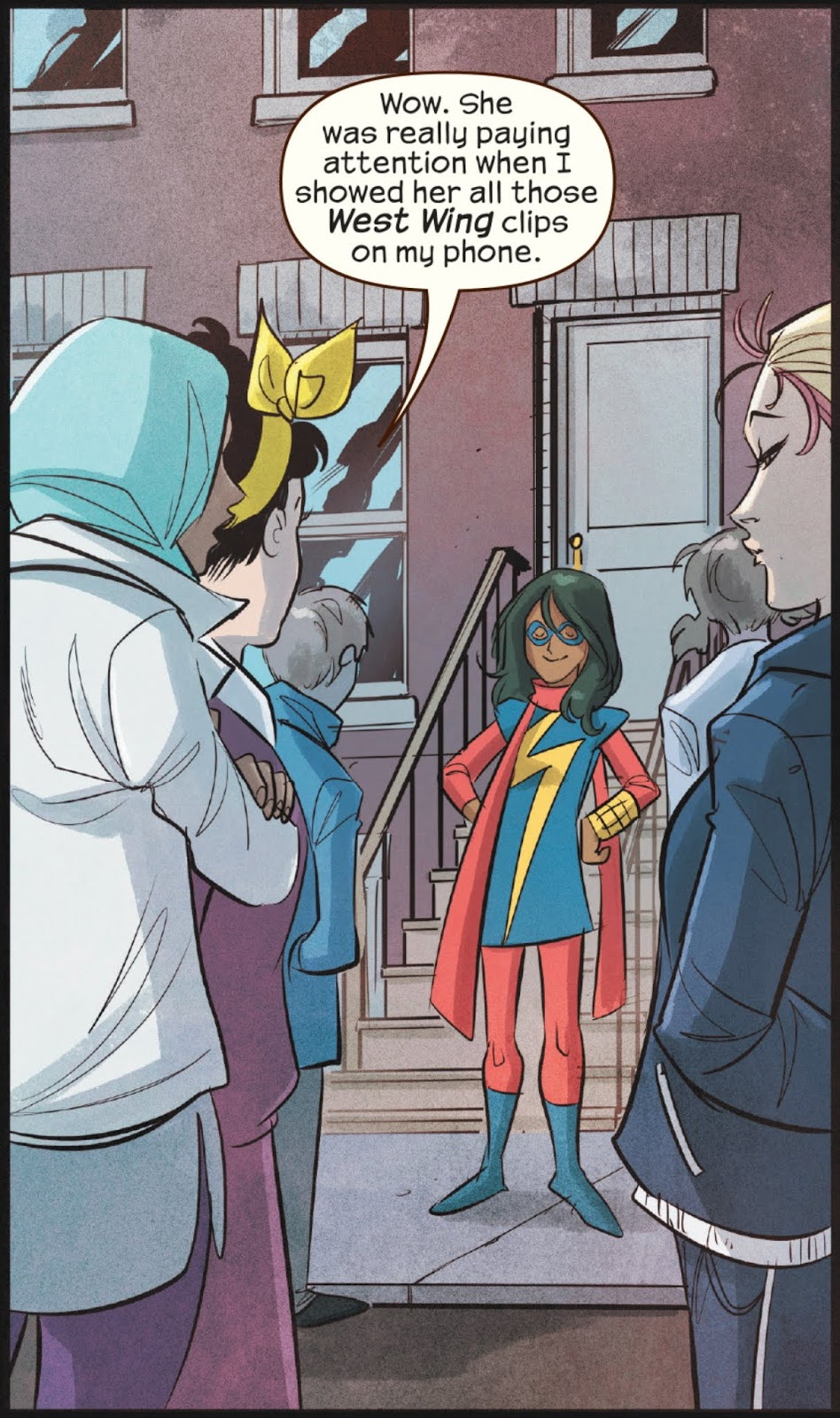
Nakia figures out Kamala's identity. From Ms. Marvel Vol. 4 #13 (Nov 2016). Art by Mirka Andolfo. Copyright © Marvel Entertainment. 
While the intention of this panel was most likely to infer that Nakia was impressed with the speech, I also interpreted it as a subtle indication of Nakia recognizing Ms. Marvel’s words as familiar, thus putting two and two together and overcoming her previous biases towards Jersey City’s resident hero. In regards to Zoe, she was more forward in implying her knowledge of Ms. Marvel’s true identity. When the evil sentient computer virus Doc.X threatened to out Zoe as a lesbian during the DAMAGE PER SECOND arc, Ms. Marvel stressed that the Doc.X virus could also potentially reveal her secret identity as well, to which Zoe replied, “If your life is anything like mine, most of the people you love already know your secrets. They’re just waiting for you to be ready to talk about it.”

Zoe alludes to knowing Ms. Marvel's identity. From Ms. Marvel Vol. 4 #16 (Mar 2017). 
Art by Takeshi Miyazawa. Copyright © Marvel Entertainment. 
This sentiment is reflected by Mike here in ONE NIGHT ONLY as I mentioned previously. Speaking of Mike, she suggests to knowing who Kamala really is during the TEENAGE WASTELAND arc when she's revealed to be in possession of Ms. Marvel’s locator pendant after witnessing the latter discard it during the CIVIL WAR II tie-in arc.

Mike hints at knowing Ms. Marvel's identity. From Ms. Marvel Vol. 4 #27 (Feb 2018). Art by Nico Leon. Copyright © Marvel Entertainment. 
The catch is that when Kamala discarded the pendant she did it in her civilian persona, meaning that Mike definitely knew that she was Ms. Marvel. Overall, the twist of Kamala’s friends knowing her true identity feels earned and doesn’t come out of left field due to solid built up from previous issues.

In large measure, MS. MARVEL #31, “One Night Only” stands tall as my second favorite MS. MARVEL story and as one of the best milestone stories to be published by Marvel. The issue wonderfully celebrates Ms. Marvel’s anniversary through the collaborative efforts of eight creators while never feeling messy or cluttered. It encapsulates all of the elements of Kamala’s past, present, and future that have made the character so appealing, but most especially it reflects the growth and development of Kamala and her relationships with her friends over the course of fifty issues. It was recently announced that following February 2019, G. Willow Wilson will be leaving MS. MARVEL after having written sixty issues and that the series will be relaunched in March as THE MAGNIFICENT MS. MARVEL with writer Saladin Ahmed (one of the guest writers featured here) at the helm. While this does sadden me, I simultaneously understand and sympathize with Wilson’s decision as she feels that she’s contributed all she has to offer to the series and that it’s time for her to move onto future projects. And just as MS. MARVEL #31 stresses the importance of progressing towards a brighter future, I wish both her and Ahmed good luck in their respective endeavors. Have a Merry Christmas and a Happy New Year!

“I will live in the past, the present, and the future. The Spirits of all Three shall strive within me. I will not shut out the lessons that they teach!”
-Charles Dickens, A Christmas Carol

Thursday, October 4, 2018

Comic Review: Ms. Marvel (Vol. 8): Mecca

Writer: G. Willow Wilson

Artists: Marco Failla & Diego Olortegui

Arguably Ms. Marvel’s best story thus far! MECCA is reflective of the current issues we face today!

Ranking: ⭐⭐⭐⭐⭐

The concept of an “allegory,” or a story that can be read from both literal and figurative perspectives is one that has existed all throughout human history. From classical fables of the ancient Greek philosopher Aesop to the modern political satire of George Orwell, allegories are often employed by writers as a method of commentating on individual, societal, and political issues through the usage of symbolism and metaphor rather than direct reference. George Orwell’s novel ANIMAL FARM, on the surface, appears to be a simple story about a group of farm animals that rebel against their corrupt owners but end up creating a society that’s just as bad, if not worse. In actuality however, the novel is designed to serve as a critique on Russian Communism and the totalitarian regime of Joseph Stalin. Comic books also are no strangers to the usage of allegories, with the most famous example being the X-Men. X-MEN is unique in how it handles allegory. While its mutants are metaphorical representatives for oppressed minorities, it is more overt in its discussions about racism and homophobia, with the fictional island nation of Genosha’s treatment of mutants symbolizing South African Apartheid, or the Legacy Virus serving as a metaphor for the AIDS epidemic of the 1980s.

These examples serve as a nice transition into discussing the form of allegory known as satire, in which an author targets a specific subject or issue in his work, usually one that’s political in nature. While the aforementioned ANIMAL FARM is perhaps the most famous example of political satire, two important instances of this in the realm of comics are Frank Miller’s BATMAN: THE DARK KNIGHT RETURNS and Alan Moore’s WATCHMEN, two of the most critically acclaimed graphic novels of all-time. Although both books are primarily about superheroes and themes of vigilantism, both Miller and Moore decided to have their stories take place in semi-realistic settings that reflected American society in the 1980s. Miller, for instance, uses this type of setting in TDKR to satirize the mass media and the Cold War politics of the Reagan administration (primarily through the usage of talking news heads), while Moore’s WATCHMEN portrays an alternate America in which the existence of superheroes would have changed key historical events such as U.S. obtaining victory in the Vietnam War or Nixon passing an amendment that allowed him to serve for three terms. Regardless of its form, allegory continues to remain an important literary device. It allows authors to create stories that reflect and comment on the issues of their respective societies at the time.

Such is the case with the eighth volume of the hit-series MS. MARVEL, “Mecca,” which serves as an allegorical satire discussing the political and cultural issues that currently predominate American society. As I mentioned way back in my review of MS. MARVEL (VOL. 1): NO NORMAL, the new Ms. Marvel, Kamala Khan, is quite easily one of the most important comic book characters created in the past decade.

Ms. Marvel, a.k.a. Kamala Khan, punching a bank robber. From Ms. Marvel Vol. 3 #6 (Jul 2017).
Art by Jamie McKelvie and Matt Wilson. 
Copyright © Marvel Entertainment.
Conceived by both writer G. Willow Wilson and editor/Vice-President of Content and the character development at Marvel, Sana Amanat, Kamala Khan is a Pakistani-American Muslim teenager who gains polymorph powers after being exposed to the mysterious Terrigen Mist. I personally loved MS. MARVEL (VOL. 1): NO NORMAL, and praised Wilson’s writing for her nuanced portrayal of Muslim American characters, fleshing them out to where they felt like genuine human beings and that their religion was not their only defining character trait. And I’m not alone in that opinion as MS. MARVEL has proven to be critically and financially successful. The first issue was listed as Marvel’s top-selling digital comic and was one of the company’s few books to receive a seventh printing. The series also won the Hugo Award in 2015, the Dwayne McDuffie Award for Diversity in Comics in 2016, and has been nominated for six Eisner Awards (essentially the Oscar-equivalent for comics). Furthermore, Kamala’s success has contributed to Marvel’s increasing attempts to appeal to wider demographics, which has been evident through the diversification of older characters such as making Thor a woman and having Iceman come out as gay, as well as the creation of new diverse characters such Riri Williams (Ironheart), an African American girl from Chicago who built her own version of the Iron Man armor. I have personally followed every single one of Kamala’s adventures since her first issue and have loved each volume for its stellar writing, complex characters, near-perfect balancing of humor and drama, and its exploration of adolescence, heroism, and even issues that affect minority groups in America ranging from gentrification to racial profiling. In fact, Kamala Khan may very well be my second favorite superhero of all-time (right behind Spider-Man), as although she adheres to a different faith, she's incredibly relatable due to her nerdy personality and struggles to find her place in life. But most especially, Kamala's fierce determination to help others simply out of the kindness and decency in her heart makes her an inspirational figure for others to follow. While Linkara once described Superman as "the most human superhero of them all" in his review of KAMANDI AT EARTH'S END #1, I personally think that Kamala fits that bill even better than Clark Kent!

Despite the success and popularity of MS. MARVEL, however, it, along with all of Marvel’s other books starring new diverse characters, has recently become subject to massive criticism from far right-wing fans. Their criticism led to the formation of an online movement called Comicsgate sometime between October 2016 to July 2017. According to an article by Buzzfeed, the proponents of Comicsgate “[use] racist, sexist, and sometimes threatening language to intimidate [’SJWs’ or ‘social justice warriors,’ which refers to] people [who advocate] for diversity in the [comics] industry.” Prominent Comicsgate members like Richard C. Meyer, creator of the ironically named YouTube channel “Diversity and Comics,” have made repeated attacks against diverse characters like Ms. Marvel in the form of unscripted videos with clickbait titles like “MS. MARVEL Is SJW Propaganda On Almost Every Page” and “MS. MARVEL Is Another SJW ‘Hero’ Who Is Obsessed With Being Oppressed.”

Richard C. Meyer's "Reviews..."
Meyer has frequently made inaccurate and offensive statements about the content and creators of MS. MARVEL, like saying that the book is racist towards white people, that it promotes left-wing propaganda, and he has repeatedly called Wilson a “self-hating white woman” and a “fake cosplay-Muslim who converted to Islam solely for the oppression.” The reason I bring all of this up is that Meyer's racist rhetoric, the growth of Comicsgate, and the derision of diverse characters and creators is eerily reflective of the current state of American politics. Alt-right hate speech has unfortunately become more mainstream in recent years, and US government policies have been increasingly hostile towards immigrants and minority groups during the current presidential administration. And since both G. Willow Wilson and Sana Amanat are Muslim and are therefore especially affected by these rising negative trends, it makes sense that one of latest volumes of their MS. MARVEL series would be utilized to critique these issues. And thus, MS. MARVEL (VOL. 8): MECCA serves as an effective story with multiple layers of allegory and symbolism, while also being a well-written and character driven narrative in its own right that ties up loose plot threads from the previous volumes, making it arguably the best story arc of the series to date!

(As a brief aside, while the MS. MARVEL (VOL. 8): MECCA TPB contains both the “Mecca” and “Northeast Corridor” arcs of the series, I’ll only be focusing on the “Mecca" arc for this review. While the NORTHEAST CORRIDOR arc was a fairly enjoyable storyline in its own right, it’s MECCA that steals the spotlight here!). 
The MECCA arc opens on the outskirts of Jersey City where Kamala and her family are preparing to celebrate the Islamic holiday Eid al-Adha. After a humorous sequence in which Kamala fails to convince her father not to sacrifice a goat for the holiday feast and her sister-in-law Tyesha is revealed to be eight-months pregnant, the Khan family returns home only to discover that their neighborhood has been blocked-off with series of signs stating “Bring Back the Real Jersey City!”

The Khan's holiday is interrupted. From Ms. Marvel Vol. 4 #19 (Jun 2017). Art by Marco Failla. Copyright © Marvel Entertainment.
While the rest of her family and neighbors celebrate their feast for Eid, Kamala decides to investigate the situation when she is randomly stumbled upon by agents of the newly formed organization K.I.N.D. (the Keepers of Integration, Normalization, and Deference), an agency conceived by the newly and illegally empowered mayor of Jersey City Chuck Worthy. In actuality however, Kamala knows that Worthy is secretly a member of the Neo-Nazi terrorist organization HYDRA, who had attempted in the previous volumes of the series to seize control of the city through neighborhood gentrification and gerrymandering the mayoral elections. Despite having been defeated by Ms. Marvel on both occasions, Worthy and K.I.N.D. managed to usurp Jersey City’s rightful Mayor, Stella Marchesi, and have now issued an executive order forcing all residents with superpowers to register their status or be forcibly deported from the city limits. Recognizing these policies as familiar, Ms. Marvel soon discovers that Mayor Worthy is in league with the main antagonist from the CIVIL WAR II tie-in arc, “Basic” Becky St. Jude (a.k.a Lockdown), alongside a mysterious new villain named Discord.

Mayor Worthy and his agents Discord & Lockdown. From Ms. Marvel Vol. 4 #20 (Jul 2017). Art by Marco Failla. Copyright © Marvel Entertainment.
Although Discord’s face is hidden by a mask, Ms. Marvel believes that he is someone she has previously met, as he knows all her weaknesses and seems to hold a personal grudge against her. As Ms. Marvel struggles to fight against Lockdown and Discord, the agents of K.I.N.D. suddenly arrest Kamala’s older brother Aamir, as he was accidentally granted temporary superpowers during the LAST DAYS arc of the series. With her brother in danger and Discord relentlessly pursuing her, will Kamala manage to defeat K.I.N.D. and bring down the fascist regime that has seized control of her city? And even if she does succeed, will she be able to come to terms with the fact that there are some evils dwelling within the hearts of people which cannot be fought?

Out of all the volumes that I have read of MS. MARVEL, the MECCA arc easily stands as my personal favorite storyline from the series thus far! Not only is it very well-written with solid character development and resolutions for previous story arcs, but it’s also highly topical and relevant, providing complex allegories and metaphors for various issues that we as a society are currently dealing with today. In my opinion, the best type of symbolism is that which can be interpreted on multiple levels in various ways rather than just one. MS. MARVEL (VOL. 8): MECCA excels in this regard, as the HYDRA takeover plotline can be interpreted as either an allegory for the controversial policies of the current presidential administration, or for the backlash against Marvel’s lineup of new diverse characters from Comicsgate supporters. For instance, Mayor Worthy’s executive order requiring mutants, inhumans, or any person with superpowers to disclose their status or face deportation is primarily reflective of Donald Trump’s immigration reforms and travel bans. These parallels are clearly made evident with Discord’s statements of “Jersey City is done with super heroes… we are getting back to normal,” and “[we’re] making life in New Jersey so inconvenient for super-powered folks that they’ll self-deport back to New York.” 

Discord threatens to deport Jersey City's superhuman population. From Ms. Marvel Vol. 4 #20 (Jul 2017).
Art by Marco Failla. 
Copyright © Marvel Entertainment.
But while Wilson’s primary intention was likely to draw parallels to the Trump administration, an individual could simultaneously interpret the HYDRA takeover as metaphors for Comicsgate and the rise of alt-right hate speech. The scene in which this is most clearly evident is where Ms. Marvel asks the former mayor Marchesi for advice on how to stop Mayor Worthy and K.I.N.D., Marchesi states that “Chuck Worthy has tapped into the fear that lies at the heart of all other fears… greed. The desire for more fueled by the fear of losing what you already have.”

Stella Marchesi discusses "the fear that lies at the heart of all other fears." From Ms. Marvel Vol. 4 #20 (Jul 2017).
Art by Marco Failla. 
Copyright © Marvel Entertainment.
While Marchesi’s dialogue is highly reminiscent of the tactics that Trump uses to appeal to the far-right, it can also be used to refer to the dissatisfaction and anger demonstrated by Comicsgate. Although Marvel in recent years has sought to appeal to a greater audience than just adolescent white males, there was a small vocal minority of that original audience who were not in favor of making superheroes more multicultural and ethnically diverse. Consequently, when Marvel began introducing new characters like the African American-Latino Miles Morales and the Muslim American Kamala Khan, or replaced older white heroes with new characters like a female Thor or a Korean American Hulk, this vocal minority feared that they were being robbed of the voice they once possessed. And just like the Mayor Worthy convinced a minority of Jersey City residents in MS. MARVEL that Kamala was “trying to force super hero garbage” on them, prominent Comicsgate members like Meyer have managed to convince this vocal minority of fans that Marvel is trying to push an “SJW agenda” onto the readers, tapping into the fan’s greed just like Marchesi describes to Kamala. Wilson is to be complimented for her ability to weave together an allegorical narrative that is topical and relevant on so many levels.

While the metaphors and parallels Wilson provides are highly informative, they never become overly preachy or distracting from the overall narrative of the MECCA arc as she utilizes them to fuel a character-driven narrative centered primarily around Kamala, Aamir, and Discord. Kamala’s arc is given the most attention, as MECCA serves as a major turning point for Kamala's character development throughout the series. She comes to the important realization that despite all of her efforts and good intentions, there are some evils that are impossible to fight, evils that dwell deep within the hearts of average people. This revelation is made light to Kamala during her first encounter with Discord, as the masked man quickly subdues her and forces her to remember what she witnessed when she thwarted Chuck Worthy’s previous HYDRA real-estate plot and rigged mayoral campaign. While in the moment she was solely focused on stopping the bad guy, it is only in hindsight that she realizes each time there were crowds of people supporting Worthy, failing to consider that there were people who openly supported Worthy's toxic ideas and rhetoric and that not “everybody agrees with [Ms. Marvel’s] agenda” as Lockdown earlier described. 

Kamala learns about the silent majority. From Ms. Marvel Vol. 4 #19 (Jun 2017). Art by Marco Failla. Copyright © Marvel Entertainment.
Wilson further fleshes out Kamala's development in this volume by tying it into events from previous books of the series. During the ARMY OF ONE arc Kamala created clones of herself in an effort to balance her overwhelmingly busy schedule, which ended up rapidly multiplying into an army that ran amok in Jersey City and caused a lot of property damage (which was made no better by the inclusion of a cloned t-rex designed specifically to eat the clones). Additionally, during the CIVIL WAR II arc Ms. Marvel briefly supported Captain Marvel's predictive justice program, which relied on an Inhuman psychic to detect future crimes and prevent them before they occurred. However, Ms. Marvel soon turned against Captain Marvel when she learned that the program basically amounted to violation of due process, kidnapping, and profiling, as not only was her classmate Josh Richardson illegally arrested, but her childhood best friend Bruno nearly got himself killed and crippled for life while trying to break him out.

These past mistakes come back to haunt Ms. Marvel during the MECCA arc despite her previous attempts to rectify them. Not only are the clone army and dinosaurs are used by Discord and Mayor Worthy as political propaganda against Ms. Marvel and Jersey City's superhuman population, but Discord holds a personal grudge against Ms. Marvel because of her involvement in the predictive justice system. This, combined with Ms. Marvel's aforementioned efforts to stop Worthy's real-estate and election schemes, results in her being scapegoated as a public menace and the silent majority being unwilling to acknowledge her previous heroic deeds or the Mayor's obvious associations with HYDRA. Consequently, Kamala begins questioning herself and her superhero activities just like the public. The major turning point, however, is the discovery of Discord's true identity. Without going into spoilers, when his mask is finally removed it's revealed that Discord is indeed someone that Kamala is familiar with despite never having witnessed him supporting fascist ideologies beforehand. This revelation heavily affects Kamala on an emotional level as it forces her to come to terms with the fact that the things people might perceive as familiar or safe are not always what they seem to be. She learns how specific circumstances can reveal that individuals who once appeared to be rational and reasonable on the surface may actually believe in ideologies that are controversial or dangerous. Therefore, Kamala is forced to ponder whether or not these toxic ideologies have always existed within the hearts of people like Discord and if they're truly representative of who they are, which in turn causes her to doubt both her own place in the world and her mission as a superhero.

While Kamala is inflicted with feelings of self-doubt in light of these revelations, she understands that she still has a moral obligation as Ms. Marvel to protect the people of her city. She realizes that the silent majority's animosity towards her and super-powered peoples does not give them the right to place their own grievances above the law, and that there are still people who believe and are depending on her. Thus Ms. Marvel continues to stay true to her ideals and keeps fighting against the corrupt HYDRA regime which threatens to ruin the livelihood of her older brother and the superhuman population. The scene in which this development is most effectively illustrated is where Ms. Marvel unmasks Discord. While she does convey feelings of sadness and remorse towards him, she simultaneously understands that she cannot excuse his actions as he's still an individual who wrongfully succumbed to the temptations of far-right extremism and fascism. Essentially, even though Kamala wants to believe that Discord is an inherently better person underneath, she recognizes that he was the one who ultimately made the choice to join HYDRA and help oppress superhuman minorities. Therefore, Ms. Marvel acknowledges that Discord is still her enemy regardless of his reasons or whatever sympathy she might feel.

Ms. Marvel continues to oppose Discord. From Ms. Marvel Vol. 4 #22 (Sep 2017). Art by Marco Failla. Copyright © Marvel Entertainment.
The decision to not condone Discord reflects an astonishing level of maturity for Kamala and is further indicative of her overall character arc in MECCA. In large measure, Kamala’s character arc is the reason why the story is titled “Mecca” in the first place. Although she does not go on a physical pilgrimage to the actual Holy Islamic city, she does experience a spiritual pilgrimage as the HYDRA takeover of Jersey City forces her to realize that not everything is what it seems, that some evils cannot be fought, and that although she’ll endure hardship and failure in her mission she must stay true to herself and others even if there are some people who will never agree with her actions or who she is. It's these revelations that further develop Kamala into "the most human superhero of them all" in my opinion, as it's not just her kindness and willingness to do good that makes her a hero, but also her ability to continue to do good even when confronted with external and internal doubt. And since the entire story takes place over the two-day period of Eid al-Adha, the holiday in which millions of Muslims embark on the pilgrimage to Mecca, Kamala’s psychological journey of self-discovery resonates with the reader on a much deeper level.

The other two characters that Wilson provides great care and attention to are Aamir and Discord. Aamir has been an interesting character throughout the series as while he is naive and overly pious to the point that he refuses to have a bank account or job (a running gag throughout the series), and possesses conservative religious views while dressing in traditional Islamic clothing, he has been portrayed as a kindhearted individual who loved his family and little sister, and appeared to know more than he let on. Wilson ingeniously used his character to shatter stereotypes as while the character self-identifies himself as “traditional and conservative” he was not ashamed of who he was, openly despises violence, and he was willing to put the needs of his family before himself and do whatever he could to protect them. This was best demonstrated when Aamir was kidnapped by Kamala's evil ex-crush Kamran during the LAST DAYS arc, and Aamir stood up to Kamran, telling the latter to stay away from Kamala.

Aamir defends his sister from Kamran. From Ms. Marvel Vol. 3 #18 (Sep 2015). Art by Adrian Alphona. Copyright © Marvel Entertainment.
These character traits demonstrated by Aamir come full circle in the MECCA arc. Since Aamir was forcibly granted temporary superpowers back when he kidnapped, he is now targeted by K.I.N.D. for being an unregistered superhuman. This label placed on him leads to a brilliant scene where Aamir is apprehended by K.I.N.D. while delivering food to his neighbors, and Aamir immediately assumes that he was arrested due to his traditional Islamic appearance and attire. Wilson not only draws further real-life parallels as K.I.N.D. threatens to have Aamir's U.S. citizenship revoked since their policies classify undisclosed super powers as a form of immigration fraud, but she also uses this scene to have Aamir give an eloquent speech about the causes of domestic terrorism. Aamir states that the individuals most likely to succumb to extremism are those who don’t understand their faith, feel alienated and ostracized by society and/or their peers, or have pre-existing vices plaguing their lives like domestic abuse or drugs. And according to Aamir, it’s those factors which make those individuals “vulnerable to whatever vulture is circling overhead, selling death and despair as a way through the gates of paradise.” 

Aamir discusses the causes of terrorism. From Ms. Marvel Vol. 4 #20 (Jul 2017). Art by Marco Failla. Copyright © Marvel Entertainment.
Aamir’s speech is brilliantly executed. It’s not only disturbingly accurate to the causes of real-life extremism, but Wilson also integrates it into the context of the story. When Aamir states that people “get radicalized when they think the only way they can have a starring role in their lives is by playing the villain,” the panels zoom-in and focus on Discord’s masked face as he’s watching the interrogation.

Discord watches Aamir's interrogation. From Ms. Marvel Vol. 4 #20 (Jul 2017). Art by Marco Failla. Copyright © Marvel Entertainment.
This focus infers to the reader that although Aamir is specifically referring to domestic Islamic terrorists in his speech, his words can also apply to Discord, who is a super villain taking his anger out on society by illegally arresting and deporting super-powered people. Discord is eventually revealed to be a person who felt alienated and ostracized and that a vulture in the form of his accomplice Lockdown took advantage of his negative emotions. Acting like the “junior fascist” Bruno previously described her as in CIVIL WAR II, Becky was able to radicalize Discord into becoming a super villain since he felt that he lacked a purpose in life. And as Aamir stated in his speech, “the most dangerous thing of all [is] when you don’t have a story to tell about who you are and what your purpose is.” In that sense, Discord may very well be the most multilayered and realistic antagonist for Ms. Marvel that Wilson has crafted to date as his character truly demonstrates how ideas of extremism and fascism can easily corrupt individuals who lack purpose. In essence, the insight that Wilson provides for both Aamir and Discord not only contributes to the growth of their respective characters, but also furthers the topical metaphors and allegories that MECCA provides for its readers.

At the end of the day, MS. MARVEL (VOL. 8): MECCA stands as not only my personal favorite story arc of the MS. MARVEL series so far but also as one of the best comics that I’ve read in recent memory. The story serves as an effective allegory for the issues surrounding the current presidential administration and Comicsgate while simultaneously delivering complex arcs for characters like Kamala, Aamir, and Discord as well as exploring themes of self-doubt and realization, pilgrimage, and the dangers of extremism and fascism. Although the current state of both American politics and comic book fandom is quite disheartening, it is important that we have characters like Ms. Marvel in our lives, who serve as a reminder of basic human kindness and decency. And like Kamala’s pilgrimage, we should continue to do good for our society even if that society is currently against what one believes in or stands for.

“Life is a pilgrimage. The wise man does not rest by the roadside inns. He marches direct to the illimitable domain of eternal bliss, his ultimate destination.”
-Swami Sivananda